Tomorrow morning Alli Bristow (recent Montana School Counselor of the Year), Hannah Lewis (awesome elementary HPE teacher), and I will travel eastbound and take the Montana I-90 exit #166 for Gold Creek. We won’t be panning for gold. Instead, we’ll get way richer than we would from finding gold—because we’re offering a couple presentations on “Happiness and You” to the Young Survivors Group at Camp Mak-A-Dream.
The Young Survivors group consists of 13-18-year-olds who have experienced brain tumors. As someone who had the good fortune and great privilege of excellent health during my teen years, I can barely imagine the strength, resilience, persistence, and family support these young people have needed to bear their medical challenges. Although Alli, Hannah, and I have powerpoints and presentation plans, our two presentations will truly be an example of us all learning together.
The Practical Psychology Podcast just dropped a new episode titled “On Happiness and a Life with Meaning.” This episode includes Kyrie Russ (the show’s host” and me in conversation about happiness, CBT, life, and other things. This conversation was based, in part, on content from a keynote I gave at a conference in Helena about 2 years ago. The ppts (which is are a bit cryptic. . .) are here:
Are you a Montana educator . . . or do you know one?
If so, maybe you—or your friend—would like three (3) bargain-rate University of Montana graduate credits. As you may know, we’ve got an online and asynchronous “Happiness for Teachers” course starting on June 17 for only $195 and the credits (or OPI hours) can contribute to raising teacher salaries. Given all that teachers do for our youth and society, it’s the least we can do. And we can do it thanks to a fantastic grant from the Arthur M. Blank Family Foundation (AMBFF: https://blankfoundation.org/).
Because I’ve written about this opportunity before, this time I want to focus on outcomes. We’ve taught this course to teachers as asynchronous semester-long courses last summer (2023) and this spring (2024). I just finished crunching the numbers for our spring outcomes; I’ve got the summer outcomes in front of me as well.
We’ve pre-post data on 16 different outcome measures. For last summer, we had statistical significance on 12 of the 16 outcomes. For this spring, we had statistical significance on 13 of the 16 outcomes. Even better, based on Cohen’s guidance, many of the effect sizes are in the medium to large range.
For you stats nerds, here’s a Table describing the outcomes:
Outcome Measure
What Teachers Reported at Post-Test
Summer – 2023 – Statistical Significance (n = 40) and Effect Size (ES is Cohen’s d)
Spring – 2024 – Statistical Significance (n = 48) and Effect Size (ES is Cohen’s d)
NAPAS: Negative Affect
Fewer negative emotional symptoms (e.g., nervousness and sadness)
p < .001 ES = .671 (medium)
p < .006 ES = .389 (small to medium)
NAPAS: Positive affect
More positive emotions (e.g., “in good spirits”)
p < .001 ES = .887 (large)
p < .001 ES = .497 (medium)
CES-D: Depression
Fewer symptoms of depression
p < .001 ES = .751 (large)
p < .013 ES = .346 (small to medium)
Sleep
Better sleep
p < .001 ES = .644 (med to large)
p < .001 ES = .502 (medium)
Headaches
Fewer headaches
p < .009 ES = .393 (small to med)
p < .001 ES = .699 (medium to large)
Gastrointestinal symptoms
Less gastrointestinal distress
p < .027 ES = .315 (small to med)
p < .023 ES = .298 (small)
Colds
Fewer and less severe colds
p < .010 ES = .382 (small to med)
p < .024 ES = .298 (small)
PHQ: Total Health
Better total health
p < .001 ES = .589 (medium)
p < .001 ES = .625 (medium to large)
Days Sick
Fewer days of physical illness
P < .015 ES = .354 (small to med)
N/A
Hope-Agency
Greater goal directed energy
p < .001 ES = .704 (med to large)
p < .008 ES = .365 (small to medium)
Hope-Pathways
Greater planning to meet goals
p < .001 ES = .545 (medium)
p < .013 ES = .341 (small to medium)
AHS: Total Hope
Higher agency and pathways hope
p < .001 ES = .677 (med to large)
p < .004 ES = .416 (small to medium)
Significant Other Support
Support from a romantic partner
p < .166 ES = .158 (minimal)
p < .195 ES = .127 (minimal)
Family Support
Support from family
p < .114 ES = .194 (minimal)
p < .030 ES = .282 (small)
Friendship Support
Support from friends
p < .165 ES = .156 (minimal)
p < .177 ES = .137 (minimal)
MSPSS: Total Social Support
Combined romantic partner, family, and friend support
p < .133 ES = .181 (small)
p < .091 ES = .198 (small)
MAAS: Mindfulness
Less distracted and more tuned into the here and now
p < .001 ES = .892 (large)
p < .001 ES = .597 (medium to large)
To summarize: If Montana educators want to have less negative affect and depression, more positive emotions, greater hope, better sleep, fewer headaches, less gastrointestinal distress, fewer colds (and days of physical illness), and greater mindfulness . . . they should register and complete this course.
Good news. Yesterday, I got a mysterious email from ORCID–which stands for: Open Researcher and Contributor ID. ORCID is a global, non-profit organization. Their vision is: “a world where all who participate in research, scholarship, and innovation are uniquely identified and connected to their contributions across disciplines, borders, and time.”
Cool.
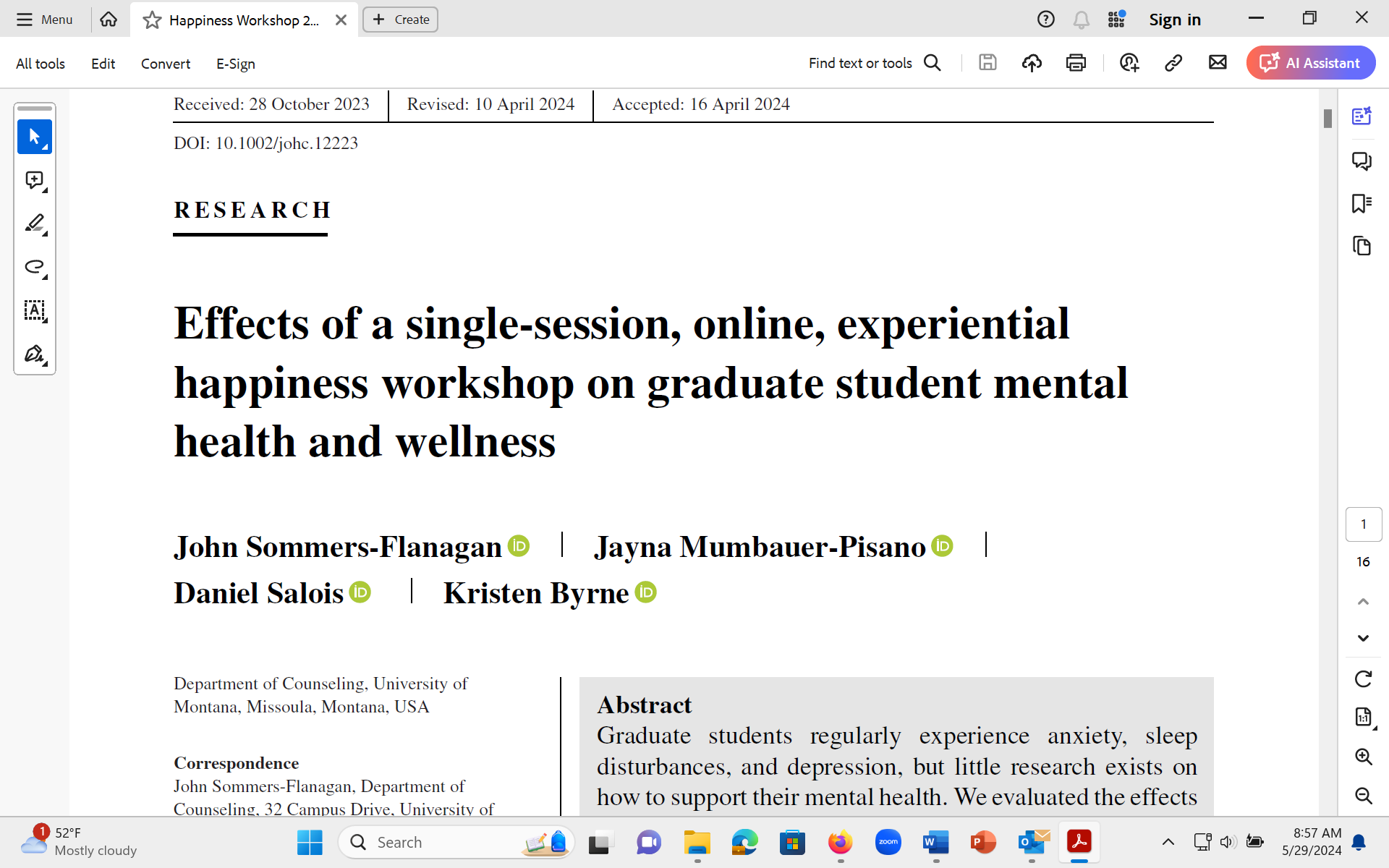
Anyway, ORCID was notifying me of a change to my ORCID record. A few minutes later, I received an email from Wiley telling me that our Happy Workshop for Grad Students article was now officially published online.
As some of you know, I’ve complained about the journal publishing process, and, although I still think it’s a pretty broken and disturbing process, working with the editors and reviewers from the Journal of Humanistic Counseling was pretty smooth and pretty fabulous. Check them out: https://onlinelibrary.wiley.com/journal/21611939
And so, without further ado, here’s the Abstract, followed by methods to access the article. . .
Effects of a Single-Session, Online, Experiential Happiness Workshop on
Graduate Student Mental Health and Wellness
John Sommers-Flanagan
Jayna Mumbauer-Pisano
Daniel Salois
Kristen Byrne
Abstract
Graduate students regularly experience anxiety, sleep disturbances, and depression, but little research exists on how to support their mental health. We evaluated the effects of a single-session, online, synchronous, happiness workshop on graduate student well-being, mental health, and physical health. Forty-five students participated in a quasi-experimental study. Students attended a synchronous 2.5-h online happiness workshop, or a no-workshop control condition. After workshop completion and as compared with no-treatment controls, participants reported significant reductions in depression symptoms but no significant changes on seven other measures. At 6 months, participants reported further reductions in depression symptoms. Moreover, across four open-ended questions, 37.0%–48.1% of workshop participants (a) recalled workshop tools, (b) found them useful, (c) had been practicing them regularly, and (d) used them in sessions with clients. Despite study limitations, single-session, synchronous, online, happiness workshops may have salutatory effects on graduate student mental health. Additional research is needed.
K E Y W O R D S: depression, graduate students, mental health, single-session, wellness
I’m writing for a little social marketing assistance to support Montana Educators.
As I’ve written before, because of the generosity and funding from the Arthur M. Blank Family Foundation, we have funding to support Montana educators. The main way we’ve chosen to support Montana educators is to offer a highly subsidized three-credit course on “Happiness for Teachers” through the fantastically helpful UMOnline people at the University of Montana.
We believe this course supports Montana Educators in three ways:
The course can be used to help increase educator pay (because we believe educators should be paid more).
The course can help educators feel positive feelings more often, savor them, increase their sense of meaning, and possibly reduce depression and improve physical health.
Educators can use the information to support their students’ happiness and well-being.
We’ve got a large section of the course open and starting on June 17. I’d love to get it all filled up.
We’ve been collecting outcomes data on our Evidence-Based Happiness course for Teachers. From last summer, we have pre-post data on 39 participants. We had VERY significant results on all of the following outcomes
If you’re not an educator, you must know one, and they deserve this, so share it, please!
Now for you researcher nerds. Over the past week, I’ve tried to fit in some manuscript writing time. If you’re following this blog, you’ll already know that I’ve experienced some rejections and frustrations in my efforts to publish out positive psychology/happiness outcomes. I’ve also emailed various editors and let them know what I think of their reviews and review processes. . . which means I may have destroyed my chances at publication. On the other hand, maybe sometimes the editors and reviewers need a testy review sent their way!
Yesterday, a friend from UC Santa Barbara sent me a fairly recent review of all the empirical research on College Happiness Course Outcomes. To summarize the review: There are HARDLY ANY good studies with positive outcomes that have been published. Specifically, if you look at U.S. published studies, only three studies with control groups and positive outcomes have been published. There’s one more I know of. If you want to read the article, here it is:
Yesterday I kicked off the MOLLI class on “Evidence-Based Happiness Practices” with a psychoeducational lecture. It was standard information about positive psychology, including Seligman’s 1998 inaugural Presidential speech in San Francisco (I was there!), the three-step emotional change trick, three good things, sleep hygiene, savoring, gratitude, forgiveness, and positive distractions. We started and ended with music, and had five-minutes of very small group interactive discussion in the middle. All-in-all, I thought it was a solid start.
This kick-off reminded me of the complex relationship between structured psychoeducation and less-structured or guided interpersonal interactions. In traditional psychoeducational groups (or classes), the emphasis is on information delivery and participant learning. Psychoeducational groups are especially important when participants can benefit from useful information. Most psychoeducational group leaders, also try to integrate some form of interactive or experiential learning into group sessions.
For me, despite the fact that I often (but not always) like listening to myself and believe I have good information to share, the MOLLI class highlight (during the whole 90 minutes) emerged right after the very small group discussions. I had given a prompt like, “I know it’s awkward to talk about your strengths, but I’d like you to share a nice story about how your own skills or talents usually come out in your relationships with others.” Participants in the room seemed engaged, but the class was hybrid, and so I wasn’t sure of the overall interaction quality. Rather than quickly moving on, I asked if one or two of the participants would share a highlight from their conversation. Silence followed. I waited through it, and finally, an online participant broke the silence with,
“At first we weren’t sure how to start, but by the end, I thought to myself, I want to be friends with these people.”
These words broke the ice in the room, and several similarly positive comments followed. What I loved about these reactions to their “talk-time” was that participants were responding in exactly the ways I had hoped, they were connecting with each other.
The balance of psychoeducational content with interpersonal connection is very cool. Sometimes—as in yesterday’s kick-off lecture—we do more psychoeducation and have less interpersonal activity. Other times, we do a five-minute lecture and follow it with 85 minutes of conversation.
One of my takeaways yesterday is to not underestimate the power of psychoeducation to stimulate conversation. Obviously, we use psychoeducation to teach. But when we use it to direct and focus subsequent conversations, we’re also using it to help people to learn from each other.
Our Evidence-Based Happiness: An Experiential Approach course through MOLLI at the University of Montana is starting soon. Note: THIS MOLLI COURSE IS OPEN TO ALL INTERESTED ADULTS, AND NOT JUST OLDER ADULTS.
This course combines one 90 min lecture, followed by 5 weeks of home assignments and small group discussion. We believe this format will offer a great balance of information, experiential learning, and talking and listening with others who are working on positive psychology practices.
You can get more info on the MOLLI course from my previous post . . . or on the MOLLI website. The clock is ticking on this one as the first meeting is Tuesday, April 2, at 1pm (Mountain Time).
We’ve been talking about emotions in our Group Counseling course at the University of Montana. Even though focusing on emotions has grown immensely in popularity within contemporary counseling and psychotherapy, some students seem to be missing a few basics. Last week, when I took time to talk about the differences between (a) reflection of feeling, (b) interpretive reflection of feeling, and (c) feeling validation most of the students found the information useful. Consequently, I’m including here (and in a following blog post or two) excerpts from the latest edition of our Clinical Interviewing textbook. https://www.wiley.com/en-us/Clinical+Interviewing%2C+7th+Edition-p-9781119981985
The foundation that guides how clinicians respond to clients is described in our “Listening Continuum” (see below).
This excerpt is from the section in Chapter 4 on Reflection of Feeling.
*****************************
Reflection of Feeling (aka Empathy)
The primary purpose of a reflection of feeling is to let clients know, through an emotionally focused paraphrase, that you’re tuned in to their emotional state. Nondirective reflections of feeling encourage further emotional expression. Consider the following example of a 15-year-old male (he/him) talking about his teacher:
Client: That teacher pissed me off big time when she accused me of stealing her phone. I wanted to punch her.
Counselor: You were pretty pissed off.
Client: Damn right.
In this example, the feeling reflection focuses only on what the client clearly articulated. This is the rule for nondirective feeling reflections: Restate or reflect only the emotional content that you clearly heard the client say. No probing, interpreting, or speculation are included. Although we might guess at underlying dynamics contributing to this boy’s fury, a nondirective feeling reflection focuses on obvious emotions.
Emotions are personal. Every attempt to reflect feelings is a move toward closeness or intimacy. Some clients who don’t want relational connection with you may react negatively to reflections of feeling. You can minimize negative reactions to reflections of feeling by phrasing them tentatively, especially during an initial interview:
When using reflection to encourage continued personal exploration, which is the broad goal of reflective listening, it is often useful to understate slightly what the person has offered. This is particularly so when emotional content is involved. (W. R. Miller & Rollnick, 2013, p. 59)
Emotional accuracy is your ultimate goal. However, if you miss the emotional target, it’s better to miss with an understatement than an overstatement. If you overstate emotional intensity, clients will often backtrack or deny their feelings. As we’ll discuss in Chapter 12, there’s a proper time to intentionally overstate client emotions. Generally, however, you should aim for accuracy while proceeding tentatively and understating rather than overstating clients’ emotions. Rogers (1961) would sometimes use clarification with clients after giving a reflection of feeling (e.g., “I’m hearing sadness and pain in your voice… am I getting that right?”).
If you understate a reflection of feeling, your client may correct you.
Client: That teacher pissed me off big time when she accused me of stealing her watch. I wanted to punch her.
Counselor: Seems like you were a little irritated about that. Is that right?
Client: Irritated? Fuck no—I was pissed.
Counselor: You were way more than irritated. You were pissed.
In this example, a stronger emotional descriptor is better because the client expressed more than irritation. However, any adverse effect of “missing” the emotion is minimized because the counselor phrased the reflection tentatively with “Seems like…” and then added a clarifying question at the end. Then, perhaps most important, when the client corrected the counselor, the counselor repaired the reflection to fit with the client’s emotional experience. From a psychoanalytic perspective, the repairing of emotional mirroring or empathy might be the most therapeutic part of listening (Kohut, 1984; see Practice and Reflection 4.3 to practice emotional responses to clients).
Reflections of feeling are often labeled as empathy. If only empathy were so simple. As Clark noted, “Rogers . . . was appalled by this . . . as the rich and nuanced process of empathy was reduced to trivial and repetitive expressions of a therapist identifying a client’s feelings” (p. 23). As we move forward through this chapter and other content on more directive interviewer responses, remember that empathy should be woven into nearly every therapist utterance, including confrontation, advice, and behavioral homework (Clark, 2023).
With clients, mental health professionals engage in emotional clarification, exploration, validation, and education. Your role varies depending on your clients’ needs and situation. As a technique, reflection of feeling aids clients in clarifying and exploring their emotions. For this chapter and reflection of feeling, the best path is a tentative one, wherein you function as a mirror to help clients experience and articulate their emotions with greater clarity. Doing so can serve to help clients explore and gain greater understanding of their emotional worlds. To accomplish your interviewing goals, you don’t need to know everything about the academic and popular debates over emotions; instead, you partner with clients to deepen your mutual understanding of the emotional experiences.
[Several pages of the text are skipped here]
Gender, Culture, and Emotion
Imagine you’re in an initial clinical interview with a Latino (he/him) cisgender male husband and father. He looks unhappy and your impression is that he’s angry about his wife’s employment outside the home. You’re aware that some Latine/x people have traditional ideas about male and female family roles. This knowledge provides you with a foundation for using a reflection of feeling to focus on his anger:
I’m getting the sense that you’re a little angry about your wife deciding to go back to work.
He responds,
Nah. She can do whatever she wants.
You hear his words. He seems to be empowering his wife to do as she pleases. But his voice is laden with annoyance. This leads you to try again to connect with him on a deeper level. You say,
Right. But I hear a little annoyance in your voice.
This reflection of feeling prompts an emotional response, but not the one you hoped for.
Sure. You’re right. I am annoyed. I’m fucking annoyed with you and the fact that you’re not listening to me and keep focusing on all this feelings shit.
This is a dreaded scenario for many clinicians. You take a risk to reflect what seems like an obvious emotion, and you get hostility in return. Your emotional sensitivity and effort at empathy backfires. The client moves to a defensive and aggressive place, and a relationship rupture occurs (see Chapter 7 for more on dealing with relationship ruptures).
It’s tempting to use culture and gender to explain this client’s negative reaction to your reflection of feeling. But it’s not that simple.
Although culture, gender, race, and other broad classification-based variables can sometimes predict whether specific clients will be comfortable with emotional expression, individual client differences are probably more substantial determinants. Comfort in expressing emotion is often a function of whether the client comes from a family-neighborhood-cultural context where emotional disclosure was a norm. For example, Knight (2014) reported that Black and Latino males who were unlikely to disclose to their peers attributed this tendency to their experiences living in violent communities. These young men learned that emotional expression and trusting others were bad ideas in their neighborhoods. Conversely, emotional disclosure is more likely in the comfort range of Black and Latine/x males raised in safer communities. This makes good common sense: Whether clients perceive you as safe to talk with about emotional concerns probably has more to do with their backgrounds and past experiences than you.
Overall, it’s likely that clients’ willingness to tolerate feeling reflections is based on a mix of their cultural, gender, and individual experiences. Although biogenetics may be involved too, how people handle emotions is largely socialized (McDermott et al., 2019). If you have reason to suspect that your client is socialized to be uncomfortable with emotions, you should avoid emotionally specific words. Examples of emotionally specific words include angry, sad, scared, and guilty.
Instead of emotionally specific words, you can substitute words that are emotionally vague (and less intense). Later, as trust develops, you might be able to use specific emotional words. Consider the following phrases:
You found that frustrating.
It seems like that bothered you a bit.
It’s a little upsetting to think about that.
Practice and Reflection 4.4 lists examples of emotionally vague words you might use instead of emotionally specific words.
PRACTICE AND REFLECTION 4.4: USING VAGUE AND EMOTIONALLY SAFE WORDS
Emotionally Specific Words
Substitute (Safer) Words
Angry
Frustrated, upset, bothered, annoyed
Sad
Down, bad, unlucky, “that sucked”
Scared
Bothered, “didn’t need that,” “felt like leaving”
Guilty
Bad, sorry, unfortunate, “bad shit”
Note: These words may work as substitutes for more emotionally specific words, but they also may not. It will be more effective for you to work with your classmates or in your work setting to generate less emotionally threatening words and phrases that are culturally and locally specific.
[End of Practice and Reflection 4.4]
Gender diverse clients may be emotionally sensitive in ways different than clients on the gender binary. Due to their neutrality, reflections of feeling—even when accurate—can be activating if clients are sensing you’re coming from a place of judgment. Consider the following:
Counselor: You said your family is rejecting your sexual identity, and you’re feeling terribly sad about that.
Client: Wouldn’t you?
When clients have a substantial history of interpersonal rejection, emotional invalidation, and/or oppression, neutral comments from clinicians can be perceived as judgmental. In this exchange, the counselor uses an accurate simple paraphrase along, with an emotional reflection, but the client feels judged and responds defensively. Given the client’s history, feeling judged in response to neutral reflections is natural. What the client needs (to feel connected and supported) is a response that’s explicitly affirming or validating (Alessi et al., 2019). In this case, at least until rapport is established, rather than a feeling reflection, the client would likely react better to a feeling validation (“Your sadness in response to your family’s rejection of your sexual identity seems totally normal”; see Chapter 5 for information on feeling validations).
*******************************
Thanks for reading. In the coming week, there will be additional posts on the basics and nuances of working with emotions in counseling and psychotherapy.
In my Group Counseling class, I’ve experienced predictable questioning of or resistance to evidence-based happiness ideas from positive psychology. . . and so I wrote out some of my thoughts . . . which went on and on and ended with a video clip.
Hello Group Class,
I’m writing my group takeaway to your all this week. Feel free to read at your leisure . . . or not at all . . . because I’m a writer and obviously, sometimes I get carried away and write too much.
When I responded to a question last week expressing reservations about the use of positive psychology—perhaps generally and perhaps more specifically with oppressed populations—I launched into a psychoeducational lecture. Upon reflection, I wish I had been more receptive to the concerns and encouraged the class as a group chew on the pros and cons of positive psychology in general and positive psychology with oppressed populations, in particular. I suspect this would have been an excellent discussion.
Given that we have limited time for discussion in class, I’ll share more reflections on this topic here.
1. The concerns that were expressed (and others have expressed in your takeaways) are absolutely legitimate. I’m glad you all spoke up. Some people have used positive psychology as a bludgeon (claiming things like “happiness is a choice”) in ways that make people feel worse about themselves. Never do that!
2. Positive psychology is poorly named (even the great positive psych researcher, Sonja Lyubomirsky, hates the name). Among its many naming problems, the word positive implies that it’s better, preferable, and the opposite of negative—which must then be the correct descriptor for all other psychology. None of this is true; positive psychology is not “better” and, in fact, it’s not even exclusively positive.
3. The point of positive psychology is not to “take over” psychology, but to balance our focus from being nearly always on psychopathology, to being equally about strengths, joy, happiness, etc., and psychopathology. If you think of it as an effort to balance how we work with individuals, it makes more sense. The point isn’t, and never has been, that we should only focus on positive mental health regardless of how our clients and students are feeling. That would be silly and insensitive.
4. As someone reminded me in the takeaways, the sort of happiness we focus on in positive psych is called eudaimonic happiness. This term comes from Aristotle. It refers to a longer form of happiness that emphasizes meaning, interpersonal connection, and finding the sweet spot where our own virtues intersect with the needs of the community. The other side of happiness is referred to as “hedonic” happiness. Hedonic happiness is more about hedonism, which involves immediate pleasure and material acquisitions. Nearly everyone in positive psychology advocates primarily for eudaimonic happiness, but also recognizes that we all usually need some pleasure as well.
5. Individuals and groups who have been historically (and currently) oppressed are naturally sensitive to coercion, judgment, and possibility of repeated oppression. What this means for counselors (among many things) is that we need to careful, sensitive, and responsive to their needs and not our assumptions of their needs. They may appreciate us being positive and supportive. Or they may appreciate us explicitly acknowledging their pain and affirming the legitimacy of the reasons for their pain. There’s substantial research indicating that certain ethnic group expect counselors to be experts and offer guidance. If that’s the case, should we avoid offering guidance because a particular theorist (or supervisor) said not to offer guidance? I think not. Many clients benefit from going deep and processing their disturbing emotions and sensations. There are probably just as many who don’t really want to go deep and would prefer a surface-focused problem-solving approach. Either way, my point is that we respond to them, rather than forcing them to try to benefit from a narrow approach we learned in grad school.
6. Good counselors . . . and you will all become good counselors . . . can use virtually any approach to make connection, begin collaborating, remain sensitive to what clients and students are saying (verbally and non-verbally), and work constructively with them on their emotions, thoughts, sensations/somatics, behaviors, and the current and/or historical conditions contributing to their distress.
7. We should not blame clients for their symptoms or distress, because often their symptoms and distress are a product of an oppressive, traumatic, or invalidating environment. This is why reflections of feeling can fall flat or be resisted. Feeling reflections are tools for having clients sit with and own their feelings. While that can be incredibly important, if you do a feeling reflection and you don’t have rapport or a rationale, feeling reflections will often create defensiveness. Instead, it can be important to do what the narrative and behavioral folks do, and externalize the problem. When it comes to issues like historical trauma, often clients or students have internalized negative messages from a historically oppressive society, and so it makes perfect sense to NOT contribute to their further internalization of limits, judgments, discrimination, and trauma that has already unjustly taken hold in their psyche. The problem is often not in the person.
8. I know I said this in class, but it bears repeating that many people practice simple, superficial, and educational positive psychology using bludgeon-like strategies. Obviously, I’m not in support of that. That said, many people practice simplistic implementation of technical interventions in counseling (think: syncretism from theories class), and many counselors do bad CBT, bad ACT, bad DBT, bad behaviorism, bad existentialist therapy, and bad versions of every form of counseling out there. No matter which approach you embrace, you should do so using your excellent fundamental listening skills . . . so that if your client or student doesn’t like or isn’t benefiting from your approach, you can change it!
I want to end this little 1K word writing project with a video. In the linked clip, I’m doing about a 3 1/2 minute opening demonstrating a “Strengths-based approach” to suicide assessment and treatment planning with a 15-year-old. As you watch, ask yourself, “Is this strengths-based?” Can you identify anything that makes this approach strengths-based or as including even a whiff of positive psychology. [Again, you’re not required to watch this, I’m just rambling.]
Okay. That’s all for this Sunday evening!
John
The place to click if you want to learn about psychotherapy, counseling, or whatever John SF is thinking about.







 John Sommers-Flanagan