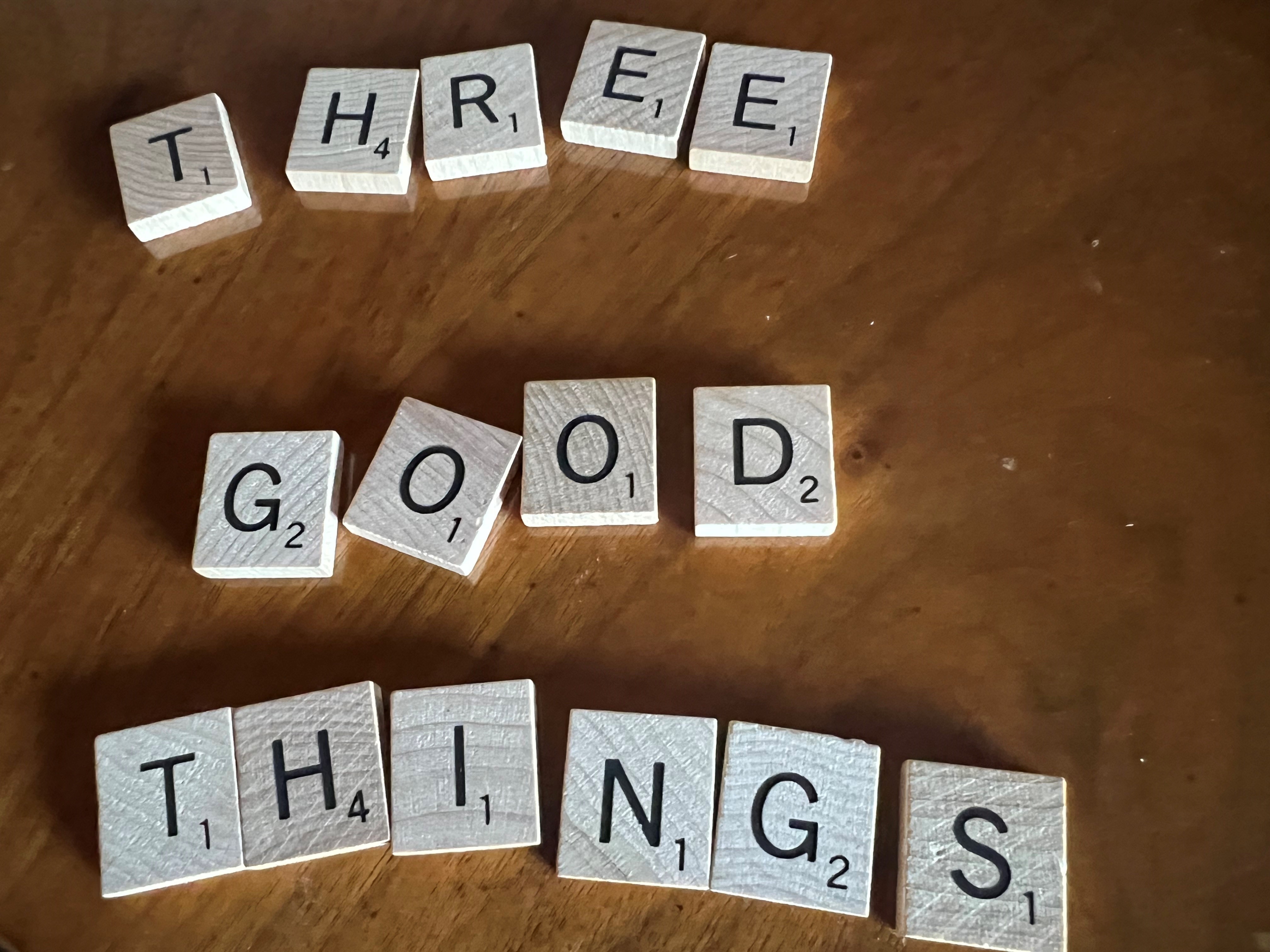
This week, for the Montana Happiness Challenge, we’re encouraging participants to experiment with Martin Seligman’s “Three Good Things” technique. Three good things (TGT) is an evidence-based positive psychology intervention. For example, six months of twice-weekly TGT has been shown to decrease burnout in nurses (Luo et al., 2019) and four weeks of unguided internet-based TGT reduced insomnia in adults (Sato et al., 2022). In Seligman’s (Seligman et al., 2005) original research, TGT had positive effects on mood and depression.
Like everything, TGT is not one-size fits all. You should use it in any way that works for you. You can start with Seligman’s instructions, and riff on it from there. For me, I like it best at 4am, when I wake up and my brain seems preoccupied with depressing things. If you want to listen to me talking about TGT, here’s a 5+ minute video: https://www.youtube.com/watch?v=45fsZMDMPOQ
If you want to read the long and winding version of this happiness activity, I’ve pasted it below the references. If not, just jump right in, try it out, and post your thoughts and reactions on your favorite social media platform.
References
Luo, Y., Li, H., Plummer, V., Cross, W. M., Lam, L., Guo, Y., . . . Zhang, J. (2019). An evaluation of a positive psychological intervention to reduce burnout among nurses. Archives of Psychiatric Nursing, 33(6), 186-191. doi:https://doi.org/10.1016/j.apnu.2019.08.004
Sato, D., Sekizawa, Y., Sutoh, C., Hirano, Y., Okawa, S., Hirose, M., . . . Shimizu, E. (2022). Effectiveness of unguided internet-based cognitive behavioral therapy and the three good things exercise for insomnia: 3-arm randomized controlled trial. Journal of Medical Internet Research, 24(2), 1-17. doi:https://doi.org/10.2196/28747
Seligman, M. E. P., Steen, T. A., Park, N., & Peterson, C. (2005). Positive psychology progress: Empirical validation of interventions. American Psychologist, 60(5), 410-421. doi:https://doi.org/10.1037/0003-066X.60.5.410
Right now, maybe more than ever, there are plenty of places, spaces, and events in the world that evoke sadness, despair, anxiety, and hopelessness. Speaking for myself, I often feel the tug of despair, despite having so many people and things in my life for which I am grateful.
The purpose of the happy places activity is to expand awareness of places where we experience meaning, safety, support, and happiness. At the same time, the purpose is also to develop awareness of places, people, and contexts, that stimulate negative affect in us, such as anxiety and unhappiness. We want to be aware of how all the many dimensions of our environments influence us.
Although awareness is important, action is equally important. It’s easy to feel trapped by all the negative things happening around us and to us. Sometimes we need to push ourselves to intentionally move out of difficult places and spaces. This movement can happen mentally. As Victor Frankl wrote in his memoir about his concentration camp experiences, people can be wholly oppressed by external forces, and yet still exercise at least some mental freedom.
The happy places activity involves recognizing our power to intentionally move toward thoughts and places that are more pleasant and meaningful. As needed, when you need a break from your heavier work, you can take yourself to happier physical or mental places; you can take yourself to a pleasant mental space, or physically go somewhere—like the beautiful outdoors of Montana. Additionally, when we develop awareness of our unhappy, or unsafe spaces, we can prepare for and develop plans for dealing with those difficult places.
Below the dancing photo, you will find the long version of the happy places activity for this week. I hope you engage with it as you are able. And please, if you feel inspired, share some of what you experience with the rest of us, either here on this blog, or on one of the social media platforms listed below.
As for myself, after having a rather rough weekend, I will be infusing some thoughts and activities around the happy places concept. Good luck to you (and me).
Active Learning Assignment 3 – Three Happy Places
John Sommers-Flanagan
University of Montana
The environment, setting, or context we’re in will directly influence our mood and sense of well-being more often than we think. This is most obvious when we’re in settings or environments that we find aversive.
To start this assignment, reflect on environments, settings, or contexts that you find aversive. For example, you may find cloudy days, rain, smoky skies (or rooms), or the news (or particular news channels) aversive or uncomfortable. Other people might find churches, schools, gyms, or libraries aversive. Your context or environment can also include people. You probably find being with some people easy, and with other people, it’s much less easy.
Often, we label particular environments, contexts, smells, and people as emotionally “triggering.” Naturally, we often feel like avoiding emotionally triggering environments. Sometimes that’s possible. However, if you VALUE something enough (e.g., supporting your loved ones, or being involved in a theatre performance, or camping), you may be VERY WILLING to face and work through anxiety or other situationally-based emotional triggers (e.g., a natural disaster, fear of public speaking, or a bear phobia), to be with the people or do the things that you VALUE. More on this later.
Now, consider the opposite: What environments, settings, contexts, or people do you find pleasurable, comforting, or energizing? In Montana, many of us think of the outdoors, or the natural environment. In fact, researchers report that, in general, more time in the outdoors is linked to increased feelings of well-being and mental health.
The main point of this assignment is for you to explore and increase your awareness of “Your happy places.” Additionally, because we can’t always be in our happy places, we also encourage you to explore, increase your awareness of, and develop a personal coping plan for the situations, contexts, and people that you find triggering. As noted above, sometimes we want to face our fears or emotional triggers. If so, knowing yourself and making a coping plan can help.
After reading and reflecting on the above, contemplate, or write a few words, in response to the following prompts:
List three settings that usually trigger negativity or discomfort in you.
List three settings that usually trigger happiness and wellbeing in you (and be specific). These are your happy places
What can you do to prepare for or cope with challenging settings that usually cause you discomfort? (Other than avoiding them)
What can you do to increase the frequency of time you spend in environments that contribute to your feelings of wellness?
What can you do to create places or spaces in your mind that you can use (anywhere and anytime) to increase your sense of comfort and wellness in the moment?
Yesterday I had the honor of presenting for the Mental Health Academy’s Mental Health Super Summit. My presentation, titled “Interviewing for Happiness: How to Weave Positive Psychology Magic into the Initial Clinical Interview” is still available, along with the other presentations, through this link: https://www.mentalhealthacademy.com.au/summit. There were 24 hours of possible continuing education for an incredibly low cost. Presenters included, Dr. Judith Beck and Dr. Cirecie West-Olatunji Professor, Xavier University of Louisiana, and me! You can access my powerpoints here:
Participating in this event was an honor also because the event is a fundraiser for “Act for Kids,” an Australian charity “that delivers evidence-led professional therapy and support services to children and families who have experienced or are at risk of harm.” Over $110K has already been raised. Here’s the Act for Kids link: https://www.actforkids.com.au/.
Last year, for the first time, we offered the Art & Science of Happiness simultaneously as a 3 credit COUN 195 course through the University of Montana and as a non-credit course open to community members through UMOnline. The course was fully online. Many students took the course “live” and synchronously; others enrolled and completed the course at their convenience.
We had 50 students sign up for the course: 30 UM students took the course for credit; 20 were “community” members (hailing from Missoula, Browning, Billings, Pennsylvania, and Canada). Many of the UM students were 19 to 22 years-old. Many of the community members were 60 to 87 years-old. The inter-generational synergy was fabulous.
What You Get in the Art & Science of Happiness
25+ instructional hours with John Sommers-Flanagan, and occasionally Rita Sommers-Flanagan. You can experience these lectures synchronously through Zoom, or asynchronously at times that work into your personal schedule.
10+ hours of small group counseling designed to facilitate reflection, discussion, and experiencing of evidence-based happiness activities (these “lab” groups can be face-to-face or via Zoom)
8 hours of individual supportive wellness counseling with a Master’s student from the Counseling Department at the University of Montana (these services are face-to-face or via Zoom and on a first-come, first served basis, because we have a limited number of available counselors-in-training)
The cost for community UMOnline participants is $250. If that sounds expensive, think of it this way. You get 40+ total hours of a combination of large group instruction, small group counseling, and individual counseling, which translates to $6.25 an hour.
Potential Benefits
Research from the two previous semesters indicate that some (not all) participants experience:
Reduced depression symptoms (in some cases, depressive symptoms were substantially reduced)
Increased hope and optimism
An increased rate of positive emotions
A reduction in headaches
Improved sleep
Greater feelings of social connection
Comments from Previous Community Participants
“Words are inadequate to express my gratitude for the Happiness Class and your amazing expertise. Literally transforming my life after a very difficult and sad nine months; plus, it’s a heckuva lot of fun. Again, thank you.”
“I found the course interesting and rewarding far beyond my expectations.”
“I feel a major shift in my thinking. I am now more focused on gratitude and living in the moment and have developed an unexpected confidence about facing the inevitable challenges that lie ahead, a confidence that even others have noticed.”
[In response to the group counseling component] “I appreciate the interactions that I have with everyone in my group. We are all very different, yet willing to be open and share our thoughts. I wasn’t sure what this would be like and I am already liking it a lot.”
[In response to a homework assignment] “I am applying a very simple formula to myself…When I become aware of how grumpy and scared and negative I feel about an issue in our family, I consciously think of two things for which I feel grateful. It fills the basket of my emotions with more positivity and opens up a new way of approaching my worries.”
When
The course is offered “live” on Tuesdays/Thursdays from 1pm to 2:20pm, beginning on January 18, 2022, ending the week of May 9, 2022. However, because the course is fully online via Zoom, you can also take the course asynchronously.
I believe this course content is very helpful, and so I’d like to make this course available as widely as possible. Please help me by sharing this information with others. Also, because I’m paid by the University of Montana to teach this course, all proceeds are returned to the University of Montana in general, and the Department of Counseling, in particular.
On March 3, the publisher, John Wiley & Sons is offering a free day-long webinar. They’re calling it a “Psychology Thought Leadership Summit.”
Full disclosure, I’m presenting at the 2:30pm-3:15pm (Eastern) time-slot. My presentation is titled: “Interviewing for Happiness: How to Weave Positive Psychology Magic Into the Interview Process.” Here’s my presentation description:
Freud once said that “words were originally magic.” In this interactive presentation, John Sommers-Flanagan will describe how clinical interviewing involves a process of using word magic to shift clients from a locked constructivist state to receptive social constructionism. This presentation focuses on systematically integrating positive psychology (aka happiness interventions) into a standard initial clinical interview protocol. Intentionally and systematically weaving happiness interventions into initial interviews is especially important because many people are being adversely affected by social isolation and challenges associated with the global pandemic.
Some of the other presenters are very notable. For example, Derald Wing Sue is presenting “Microintervention Strategies: Disarming Individual and Systemic Racism and Bias” during the at the 9:45am to 10:45am (Eastern) time slot. Here’s Dr. Sue’s presentation description:
Microinterventions are the everyday words or deeds—whether intentional or unintentional—that communicate the following concepts to targets of microaggressions:
Validation of their experiential reality
Value as a person
Affirmation of their racial or group identity
Support and encouragement
Reassurance that they are not alone
More importantly, they serve to enhance psychological well-being, and provide targets, allies, and bystanders with a sense of control and self-efficacy.
This session provides participants with the opportunity to learn, practice, and rehearse microintervention strategies and tactics to disarm and neutralize expressions of bias by perpetrators while maintaining a respectful relationship.
In the following paragraph I’ve pasted the Wiley promo, which includes a link to sign yourself up. . . or just REGISTER HERE. It looks like you’re supposed to register very soon, so check it out.
Wiley Psychology Thought Leadership Summit
March 3, 2021
As one of the world’s leading psychology publishers, Wiley offers trusted and vital resources written by leading subject matter experts in the field. Join colleagues from across North America for the Wiley Psychology Thought Leadership Summit featuring some of our top authors. Speakers will give inspiring talks and conduct breakout sessions where you’ll gain insight and ideas to bring back to your classroom or practice. Choose from multiple sessions on March 3, 2021.Sign Me Up
Did you know you can enroll in my Art & Science of Happiness (COUN 195) course through the University of Montana as a non-credit community participant? The course is fully online via Zoom.
When: Live on Zoom every Tuesday and Thursday from 1:00pm to 2:20pm (MST), beginning January 12 and ending April 27.
What: You’ll hear and see lectures, demonstrations, video clips, small group lab activities, and role-plays.
Format: Because the course is online, live attendance isn’t required. Although I encourage live attendance, you can watch the course on your own schedule.
Cost: For community participants, the cost is $150 for the whole semester. That’s about $3.50 per instructional hour.
Please note: if you’re a University of Montana student (or want to become one) you can enroll in the course for three (3) semester credits. Go to Cyberbear, find the course (COUN 195), and enroll: https://www.umt.edu/cyberbear/.
Assignments: If you’re taking the course for credit, you’ll have quizzes, required assignments, and tracked attendance; if you’re taking the course as a community non-credit participant, assignments and attendance will be optional and ungraded. However, I will strongly encourage you to participate in the small, online lab groups. That’s where you can talk in more detail about your happiness-related experiences.
In the friendly confines of a psychological laboratory, happiness is created rather easily. In the real world, happiness is more elusive.
Whether researchers have college students hold pens with their teeth or write down three good things or express gratitude, mood is boosted. In the real world, sometimes you have to force yourself to smile, and even still, you may not experience happiness.
You might wonder, do the small behaviors that improve mood in the lab result in sustained positive moods into the future? Martin Seligman, the contemporary psychologist most closely linked to the positive psychology movement (and author of Authentic Happiness and Flourishing) says yes. Although I’m less sure about this than Dr. Seligman, I am sure that many small behaviors over time—the sorts of behaviors that become positive habits (or positive routines)—can, for many, result in improved moods sustained over time.
Instead of assuming that everything Martin Seligman or other researchers say is true, in our University of Montana happiness class (COUN 195: The Art and Science of Happiness) we’re all about directly testing evidence-based happiness strategies. Part of the reason we’re testing these strategies is because we’re replicating nomothetic scientific findings in idiographic contexts. The true originator of positive psychology, Alfred Adler, would be happy about this. That’s because Adler believed we can never know if group scientific findings generalize to individuals, until we try them out with individuals.
In the spirit of positive psychology, and in an effort to develop and maintain healthy habits in college students, I’m giving small weekly homework assignments in the UM happiness class. Sometimes these assignments are verbatim (or nearly so) from published scientific research. Other times they’re assignments that Dan Salois (my TA) and I have created just for the class. This week’s assignments are home cooking.
I’m including these assignments on my blog so you can follow along with the class and experience different approaches to creating positive moods and psychological wellness. These assignments aren’t stand-alone miracles; they’re brief and simple behaviors purposely designed to elicit positive emotions and prompt you (and the happiness students) to reflect on the nature of positive emotions and wellness-oriented behaviors. They might work as intended, or they might not. I hope they work.
You have two assignments for this week.
Active Learning Assignment 1 – Happy Songs in Your Life
Music in general, and songs in particular, can trigger happiness, sadness, other emotions, and life memories. Sometimes our emotional responses to music are all about the music. Other times, our emotional responses are about the personal links, associations, or memories that songs trigger. For example, when I listen to “Joy to the World” by Three Dog Night, I’m transported back to positive memories I had playing 9th grade basketball. The song, “Put the Lime in the Coconut” will forever take me back to a car accident that happened with my sister in 1973. It’s not unusual for us to turn to music to help regulate our emotions or to heighten particular feelings.
For this assignment, do the following:
Select a song that has triggers positive emotions for you.
Listen to the song twice in a row and just let the song do its work. You can do this with a friend or by yourself. Don’t WATCH the song. If it’s a music video, shut your eyes and listen.
After you’ve listened twice and let the positive feelings come, respond to the following prompts, and then upload your responses to Moodle.
Write the name of the song and the musical artist (so we know the song).
What emotion does the song bring up?
What’s your best guess (hypothesis) for why the song brings up those particular emotions? (Share the lyrics or the links to life events that make the song emotionally important to you).
Do you usually listen to that song to intentionally create a particular emotional state, or do you wait for the song to randomly pop into your life?
Optional: share the song with someone and tell that person why the song triggers positive emotions for you.
Active Learning Assignment 2 – Witness Something Inspiring
Inspiring things are constantly happening in the world.
Martin Luther King Day is coming. Martin Luther King was a source of great inspiration for many. Over this coming long weekend you could watch a video recording of King’s “I have a dream” speech and feel inspired. You could also go on the internet and find something inspiring on social medial. But instead, just for fun (and for this assignment), we want you to watch for and observe something inspiring that’s happening in the real world.
The inspiring event that you notice may be small or it may be big. The key part of this assignment is that it involves intentionally watching for that which will inspire. Keep all your sensory modalities open for inspiration. Then, write Dan a short note (about 200 to 300 words) describing what you experienced. Your note should include:
What it was like to intentionally pay attention to things that might inspire you.
A description of what you observed.
Reactions you had to the inspirational event.
Anything else you want to add.
*******************************
Try these assignments for yourself (or not). If it strikes your fancy, you can post your reactions on this blog (or not).
I hope the remainder of your Martin Luther King weekend is fantastic.
Yesterday I happened to meet up with a guy in a coffee shop. We recognized each other immediately. While chatting, we got coffee, sat down, and talked about positive psychology.
The meeting was neither random nor happenstance. We planned it. I know it’s silly to say that something goes without saying, and writing that something goes without saying is sillier yet, but I’m writing it anyway: Planning and intentionality are very good things. Without intentional planning, I never would have met my coffee-buddy, and I’d be less smart today than I am now.
This guy (I’ll call him Carlton, because that’s his name) was inspired to reach out to me with an email because I’m teaching a Happiness Class at the University of Montana this spring semester. He has a Master’s degree in positive psychology. He wanted to talk. Positive psychology people are like that. After using my impaired scheduling skills to mess up our first planned meeting, we were able to get together on our second try.
Carlton was abuzz with positive energy even before he drank his Americano, but that should be no particular surprise. He told me about taking red-eye flights from Seattle to Philadelphia to complete his “commuter” M.A. in positive psych. Clearly, he’s high on life, which made for an episode of fast talking and listening that got cut short by my need to drive east to Absarokee. So, what happened during this short, speedy conversation that made me smarter?
Turns out, we’re from the same hometown. I’m sure that made me smarter. After all, that was the town where I read nearly every Norman Vincent Peale book ever written. Apparently, I learned that growing up in Vancouver, Washington creates a need for positivity. But, of greater relevance was the fact that he was (another non-surprise) a treasure of information about positive psychology.
Carlton told me of some of his favorite positive psychology ideas and activities. I took notes. I’m not going into the details. Most of the information is top-secret and you’ll have to take my Happiness class to get the down low. Instead. I’m presenting you with one highlight to take with you into your weekend.
The best part—amongst many good parts—was being re-introduced to one of the biggest positive psychology names of all time. Although I knew about Christopher Peterson in a distant sort of way, I’d never really plunged into his work. Maybe that’s because I figured if I knew about Martin Seligman, then I didn’t need to know much about Chris Peterson. Or maybe it was because sometimes I have a limited and narrow take on the world. Somehow, sometimes, I presume that if I don’t know about something, it must not be all that important, or I would have already learned it. I recognize that as a terribly self-centered perspective, but it can creep into my psyche anyway, leading me down a road where I think I already know everything I need to know. When that happens, I need to do work to get around and past or through my own narrow mental world.
Carlton not only offered to lecture in my Happiness class (yet another reason to register now!), he also helped open my mind to deeper issues in positive psychology. He told me about a video where Peterson boils everything about positive psychology down to three words. The three words, “Other people matter.”
Being a big fan and proponent of Adler and social interest or Gemeinschaftsgefühl, I experienced deep and immediate love for Peterson’s three words. They were simpler and deeper than other positive psychology words and ideas I’d experienced previously. And remember, I spent most of the late 1970’s reading Norman Vincent Peale. In addition to The Power of Positive Thinking and You Can If You Think You Can, both of which I now consider mostly a load of crock (I’m not quite sure what a crock is, but I’m using crock as a euphemism so I can claim that at least some of my blogs are profanity-free). I even read some of Peale’s less popular works, like, Sin, Sex, and Self-Control. . . the reading of which may partially explain my interest in having at least some profanity-free blogs.
This morning I looked at my notes and I looked up the Chris Peterson video. Spoiler alert, my favorite part is when Peterson says:
“Sometimes when I give a talk, I tell the audience, if you really don’t want to listen to me for the next hour, listen to me for five seconds, because I’ll tell you what positive psychology is all about. Other people matter. Period. I’m done with my talk.” (Chris Peterson, Ph.D., from an interview and shown as a part of a Positivity Project video that you can watch here: https://www.youtube.com/watch?v=AEc2W8JVuRw).
Obviously, that’s an awesome quotation, and an amazing five-second talk, but I like this next Peterson quotation even better. The story is that one of Peterson’s research buddies, Nansook Park, asked Peterson how or why he gave so freely of himself to others. Peterson responded, “Other people matter and we are all other people to everyone else.”
I know everyone reading this won’t feel the tingle I feel, but I love the statement, “Other people matter and we are all other people to everyone else.” Peterson’s message is circular. If I want to be loved, then I love. Okay, maybe it’s just a knock off of the Golden Rule, which may be a knock off of ancient Egypt’s “Do to the doer to make him do.” Even so, I find the statement that “Other people matter and we are all other people to everyone else” an empowering way to think about how important it is to lead with love and kindness and respect. It’s important for them, and it’s important for us.
Now that I’ve quoted and re-quoted Peterson several times, I’m sensing that this blog is moving toward its natural conclusion. But, just like it’s hard to find the natural origin of the reciprocity maxim (i.e., Golden Rule), it’s also hard to find the natural conclusion. I could end with Adler (always a solid choice). In his boldly titled book (What life should mean to you) from 1931, Adler said that the meaning of life was to have “interest in others and cooperation.”
Alternatively, I might end with a quick summary of a 75-year longitudinal Harvard study. The researchers concluded: “Good relationships keep us happier and healthier.”
Instead, I’ll point you to a video written by Tiffany Shlain and Sawyer Steele, titled 30,000 Days. I discovered this video while in pursuit of information on Christopher Peterson (instead of being in the pursuit of happiness). Watching the 11 minute 30,000 Days video is one way to launch your upcoming fantastic weekend. Here’s the link: https://vimeo.com/226378903
The place to click if you want to learn about psychotherapy, counseling, or whatever John SF is thinking about.






 John Sommers-Flanagan