When I was teaching social skills to elementary school-aged youth, one boy couldn’t stop talking about himself. Because I wanted the students to be interactive with and interested in each other, I intervened.
“Ask a question about her.”
He nodded, in apparent understanding. Returning to the activity, he followed my instructions (sort of), immediately asking,
“What do you think of me?”
The question, “What do you think of me?” is powerful. We all wonder this, at least occasionally, and perhaps constantly. As I just wrote in a previous blog post, being seen and known by others is a profound experience. Having your strengths and positive qualities reflected back to you by others is a gift: https://johnsommersflanagan.com/2023/12/25/the-gift-of-being-seen/
The Natural Talent Interview requires vulnerability; it’s a challenging and potentially awkward assignment. I recommend it anyway. 😲
Here’s a link to the version of the Natural Talent Interview that we assign in the Happiness Course. Note: It includes a nice description of self-awareness and the Johari Window.
Rylee said there was an internet thing going around about how men should be more like women and start complimenting each other. Then we watched “Rye Lane” (two thumbs up). In the movie, the protagonist male tried out that compliment-another-guy thing; the guy he complimented told him to “Fuck off” and a few other things I won’t repeat.
Maybe compliments don’t translate all that well across genders. But maybe they do.
Years ago, I was doing psychotherapy with a Native American father and his teenage son. To try to help with their strained relationship, I coached the dad on being more authentically positive with his son. During the next session, I had them do a version of the “What’s good about you?” therapy activity.
I asked the son to sit across from his dad and ask, “What’s good about me?” ten times in a row. The only rules were that dad was supposed to give 10 different answers and respond honestly. The boy muttered along with an eye-roll. I felt nervous.
He looked at his dad and asked, “What’s good about me?”
The dad said, “You have a big heart.”
What’s good about me?
“You treat your mom with respect.”
What’s good about me?
“You love your sister.”
What’s good about me?
“You’re my son and I’m proud of you.”
The tears came slowly at first.
What’s good about me?
“You are intelligent”
It was over. They embraced, with the boy sobbing in his father’s arms.
The points: Parents can get so overfocused on providing constructive criticism to their children that their children don’t KNOW the inner strengths their parents see within them. In the preceding example, the teen boy was shocked—in a very positive way—to hear the strengths, skills, and talents that his father saw in him.
This can happen in all relationships. Nearly everyone wants to be seen and known. It’s probably easier to imagine—especially without clear and reassuring evidence—that others see our negative qualities. Our strengths can feel invisible, even to ourselves. It’s often hard to imagine that others notice anything good about us.
Some say that true self-esteem is all about self-evaluation, and not reliant on what others think of us. That’s partly true. But, it’s ridiculous to think that any of us can feel good about ourselves without at least getting occasional feedback about our strengths and positive qualities.
One new thing you can try this holiday season is to give the people you love the gift of seeing their strengths. It can be as simple as noticing and saying something that you think your friend or family member does well, like, “You’re really good at picking out just the right gifts.” Or, “You’re always so much fun to have around.” Or, “You make the best pumpkin pie.”
You can take this deeper if you want by noticing character traits and patterns. “You’re the most honest person I know, and I really value that.” “I love how you pay attention to your grandma. You are such a good person.”
Recognizing and naming the strengths and positive qualities of others is an amazing gift. You’re not just “seeing” people, you’re seeing, acknowledging, and articulating their best qualities. And by naming their best qualities, you’re not just giving them a compliment; you’re nurturing those qualities, and helping them grow.
I’ve taught a different version of this activity for years, and called it the “Natural Talent Interview.” For more on the Natural Talent Interview, which is this week’s Montana Happiness Challenge activity, go to the Montana Happiness Project’s webpage: https://montanahappinessproject.com/natural-talent-interviews
[Note: This is an edited and updated version of a post I did a year or two ago.]
Giving and receiving feedback is a huge topic. In this blog post the focus is on giving and receiving feedback in classroom settings or in counseling/psychotherapy supervision. The following guidelines are far from perfect, but they offer ideas that instructors and students can use to structure the feedback giving and receiving process. Check them out, and feel free to improve on what’s here.
Before you do anything, remember that feedback can feel threatening. Hearing about how we sound and what we look like is pretty much a trigger for self-consciousness and vulnerability. Sometimes, when we look in the mirror, we don’t like what we see, and so obviously, when someone else holds up a mirror, the feedback we experience may be . . . uncomfortable. . . to say the least. To help everyone feel a bit safer, the following can be helpful:
Acknowledge that feedback is scary.
Emphasize that feedback is essential to counseling skill development.
Share the feedback process you’ll be using
Make recommendations and give examples of what kind of feedback is most useful.
Acknowledge that Feedback is Scary: You can talk about mirrors (see above), or about how unpleasant it is for most people to hear their own voices or see their own images, or tell a story of difficult and helpful feedback. I encourage you to find your own way to acknowledge that feedback triggers vulnerability.
Feedback is Essential: Encourage students to lean into their vulnerability and be open to feedback—but don’t pressure them. Explain: “The reason you’re in a counseling class is to improve your skills. Though hard to hear, constructive feedback is useful for skill development. Don’t think of it as criticism, but as an opportunity to learn from mistakes and improve your counseling skills.” What’s important is to norm the value of giving and getting feedback.
Share the Process You’ll be Using: Before starting a role play or in-class practice scenario, describe the guidelines you’ll be using for giving and receiving feedback (and then generate additional rules from students in the class). Here are some guidelines I’ve used:
Everyone who volunteers (or does a demonstration or is being observed) gets appreciation. Saying, “Thanks for volunteering” is essential. I like it when my classes establish a norm where whoever does the role-playing or volunteers gets a round of applause.
After being appreciated, the role-player starts the process with a self-evaluation. You might say something like, “After every role play or presentation, the first thing we’ll do is have the person or people who were role-playing share their own thoughts about what they did well and what they think they didn’t do so well.”
After the volunteer self-evaluates, they’re asked whether they’d like feedback from others. If they say no, then no feedback should be given. Occasionally students will feel so vulnerable about a performance that they don’t want feedback. We need to accept their preference for no feedback and also encourage them to solicit and accept feedback at some later point in time.
Giving Useful Feedback: It’s always good to start with the positive. Try to be very clear and specific about some things you especially liked. I usually take notes to help me with this; I’ll write down exactly what the role player said and put a + sign next to it so I can say something like, “I see in my notes that I put a + sign next to your very first paraphrase. You seemed to be tracking very well and you shared what you heard with your client in a way that felt nice.
Constructive or corrective feedback shouldn’t focus so much on what was done poorly, but emphasize what could be done to perform the skill even better. Constructive or corrective feedback might sound like this: “I noticed you asked several closed questions. Closed questions aren’t bad questions, but sometimes it’s easier to keep clients talking about important content if you replace your closed questions with open questions or with a paraphrase. Let’s try that. How could you change one of your closed questions to an open question or a paraphrase?” BTW: General and positive comments (e.g., “Good job!”) are pleasant and encouraging, but should be used in combination with more specific feedback; it’s important to know what was good about your job.
Constructive feedback should be specific, concrete, and focused on things that can be modified. For example, you can offer a positive or non-facilitative behavioral observation (e.g., “I noticed you leaned back and crossed your arms when the client started talking about sexuality.”). After making an observation, the feedback giver or the group can explore potential hypotheses (e.g., “Your client might interpret you leaning back and crossing your arms as judgmental”). The feedback giver can also offer an alternative (“Instead, you might want to lean forward and focus on some of your excellent nonverbal listening skills.”).
With constructive feedback you can take some of the evaluation out of the comment by just noticing or observing, rather than judging, “I noticed you said the word, ‘Gotcha’ several times.” You can also ask what else they might say instead, “To vary how you’re responding to your client, what might you say instead of ‘Gotcha’?”
General negative comments such as “That was poorly done.” should be avoided. To be constructive, provide feedback that’s specific, concrete, and holds out the potential for positive change. Feedback should never be uniformly negative. Everyone engages in counseling behaviors that are more or less facilitative. If you happen to be the type who easily sees what’s wrong and have trouble offering praise, impose the following rule on yourself: If you can’t offer positive feedback, don’t offer any at all. Another alternative is to consciously focus on using the sandwich feedback technique when appropriate (i.e., say something positive, say something constructive, then say another positive thing).
IMHO, significant constructive feedback is the responsibility of the instructor and should be given during a private, individual supervision session. The general rule: “Give positive feedback in public and constructive feedback in private” can be useful.
Finally, students should be reminded of the disappointing fact that no one performs perfectly, including the teacher or professor. Also, when you do demonstrations, be sure to model the process by doing a self-evaluation (including things you might have done better), and then asking students for observations and feedback.
Giving and receiving feedback is a huge topic. In this blog post the focus is on giving and receiving feedback in classroom settings or in counseling/psychotherapy supervision. The following guidelines are far from perfect, but they offer ideas that instructors and students can use to structure the feedback giving and receiving process. Check them out, and feel free to improve on what’s here.
Before you do anything, remember that feedback can feel threatening. Hearing about how we sound and what we look like is pretty much a trigger for self-consciousness and vulnerability. Sometimes, when we look in the mirror, we don’t like what we see, and so obviously, when someone else holds up a mirror, the feedback we experience may be . . . uncomfortable. . . to say the least. To help everyone feel a bit safer, the following can be helpful:
Acknowledge that feedback is scary.
Emphasize that feedback is essential to counseling skill development.
Share the feedback process you’ll be using
Make recommendations and give examples of what kind of feedback is most useful.
Acknowledge that Feedback is Scary: You can talk about mirrors (see above), or about how unpleasant it is for most people to hear their own voices or see their own images, or tell a story of difficult and helpful feedback. I encourage you to find your own way to acknowledge that feedback triggers vulnerability.
Feedback is Essential: Encourage students to lean into their vulnerability and be open to feedback—but don’t pressure them. Explain: “The reason you’re in a counseling class is to improve your skills. Though hard to hear, constructive feedback is useful for skill development. Don’t think of it as criticism, but as an opportunity to learn from mistakes and improve your counseling skills.” What’s important is to norm the value of giving and getting feedback.
Share the Process You’ll be Using: Before starting a role play or in-class practice scenario, describe the guidelines you’ll be using for giving and receiving feedback (and then generate additional rules from students in the class). Here are some guidelines I’ve used:
Everyone who volunteers (or does a demonstration or is being observed) gets appreciation. Saying, “Thanks for volunteering” is essential. I like it when my classes establish a norm where whoever does the role-playing or volunteers gets a round of applause.
After being appreciated, the role-player starts the process with a self-evaluation. You might say something like, “After every role play or presentation, the first thing we’ll do is have the person or people who were role-playing share their own thoughts about what they did well and what they think they didn’t do so well.”
After the volunteer self-evaluates, they’re asked whether they’d like feedback from others. If they say no, then no feedback should be given. Occasionally students will feel so vulnerable about a performance that they don’t want feedback. We need to accept their preference for no feedback and also encourage them to solicit and accept feedback at some later point in time.
Giving Useful Feedback: It’s always good to start with the positive. Try to be very clear and specific about some things you especially liked. I usually take notes to help me with this; I’ll write down exactly what the role player said and put a + sign next to it so I can say something like, “I see in my notes that I put a + sign next to your very first paraphrase. You seemed to be tracking very well and you shared what you heard with your client in a way that felt nice.
Constructive or corrective feedback shouldn’t focus so much on what was done poorly, but emphasize what could be done to perform the skill even better. Constructive or corrective feedback might sound like this: “I noticed you asked several closed questions. Closed questions aren’t bad questions, but sometimes it’s easier to keep clients talking about important content if you replace your closed questions with open questions or with a paraphrase. Let’s try that. How could you change one of your closed questions to an open question or a paraphrase?” BTW: General and positive comments (e.g., “Good job!”) are pleasant and encouraging, but should be used in combination with more specific feedback; it’s important to know what was good about your job.
Constructive feedback should be specific, concrete, and focused on things that can be modified. For example, you can offer a positive or non-facilitative behavioral observation (e.g., “I noticed you leaned back and crossed your arms when the client started talking about sexuality.”). After making an observation, the feedback giver or the group can explore potential hypotheses (e.g., “Your client might interpret you leaning back and crossing your arms as judgmental”). The feedback giver can also offer an alternative (“Instead, you might want to lean forward and focus on some of your excellent nonverbal listening skills.”).
With constructive feedback you can take some of the evaluation out of the comment by just noticing or observing, rather than judging, “I noticed you said the word, ‘Gotcha’ several times.” You can also ask what else they might say instead, “To vary how you’re responding to your client, what might you say instead of ‘Gotcha’?”
General negative comments such as “That was poorly done.” should be avoided. To be constructive, provide feedback that’s specific, concrete, and holds out the potential for positive change. Feedback should never be uniformly negative. Everyone engages in counseling behaviors that are more or less facilitative. If you happen to be the type who easily sees what’s wrong and have trouble offering praise, impose the following rule on yourself: If you can’t offer positive feedback, don’t offer any at all. Another alternative is to consciously focus on using the sandwich feedback technique when appropriate (i.e., say something positive, say something constructive, then say another positive thing).
IMHO, significant constructive feedback is the responsibility of the instructor and should be given during a private, individual supervision session. The general rule: “Give positive feedback in public and constructive feedback in private” can be useful.
Finally, students should be reminded of the disappointing fact that no one performs perfectly, including the teacher or professor. Also, when you do demonstrations, be sure to model the process by doing a self-evaluation (including things you might have done better), and then asking students for observations and feedback.
Back in the 1950s, at the University of California, a guy named Joseph met a guy named Harrington. They were both psychologists and both interested in self-awareness and interpersonal relationships. Together, combining their knowledge and experiences, they came up with a simple way to integrate their ideas about self-awareness and social awareness. Being cool and creative types (I’m guessing about this, because I never met them), to name their concept they fused or integrated their two first names.
You may have studied the Johari Window in Introductory Psychology. Just in case you didn’t, or just in case you’ve forgotten whatever you learned about it, here are a few facts.
The Johari window is pronounced the Joe-Harry Window. . . because Joe Luft and Harry Ingham named it after themselves.
The Johari window is designed as a tool for helping people (like us!) to expand our self-awareness.
The Johari Window has four quadrants or “rooms” (see the Figure below)
The Open Area. The top-left room represents the part of the self that that’s wide open. It includes parts of you that are known to you (self-awareness) and those same parts that are known to others.
The Hidden Area. The bottom left room is the part of ourselves that we know, but that we hide from others. People who are transparent generally have a small private or “hidden area.” People who consider themselves “private people” probably have bigger hidden areas.
The Blind Spot. The top right area represents the part of ourselves that others see, but that we don’t see (or hear). Maybe you’ve glimpsed some of your blind spot by watching yourself on video, or listening to your recorded voice, or from getting feedback from other people about how they experience you.
The Unknown. The unknown is that mysterious part of ourselves that remains hidden to us and hidden to others.
Mostly, the Johari Window is useful as a tool for enhancing self-awareness and shrinking the Blind Spot and Unknown areas. You can think of it as getting to know the parts of ourselves that are unconscious or outside our awareness. As noted in the figure below (which I copied from this internet site: https://www.communicationtheory.org/the-johari-window-model/), there are methods for expanding self-awareness. The main method for expanding self-awareness is to ask others for feedback. Asking others, “What do you think of me?” is a powerful and straightforward self-awareness tool, but it requires social risk-taking and courage. Asking for feedback is a good, but not perfect method for expanding self-awareness because asking others for feedback may NOT expand your self-awareness if that other person doesn’t know you well or sees you inaccurately. Feedback from others is often, but not always, helpful for expanding self-awareness.
Another method for expanding self-awareness involves, ironically, being more open and transparent to others. If we want accurate feedback from others, it’s best to let others get to know us, otherwise the feedback and information they provide will be necessarily limited. To get good feedback from others, we need to provide others with good data about ourselves. Without good data, others can’t give us good feedback. See below for the Figure illustrating the Johari Window.
I’m writing about the Johari Window for educational reasons, but also because it’s a great way to introduce your Spring Break happiness assignment. This is an assignment that I made up about six years ago while teaching a career development class. I call it the Natural Talent Interview. Not surprisingly, because I made it up, I think it’s an awesome assignment that everyone will love. On the other hand, you should be the judge of that, AND, you should give me feedback on this assignment so I can expand my self-awareness!
Here’s the assignment:
Conduct Two Natural Talent Interviews: To do this assignment, identify two people whom you respect and trust. Let them know that you have an assignment to get more in touch with your personal strengths and talents. Then, get a note pad (or commit yourself to making mental notes) and ask them the following question:
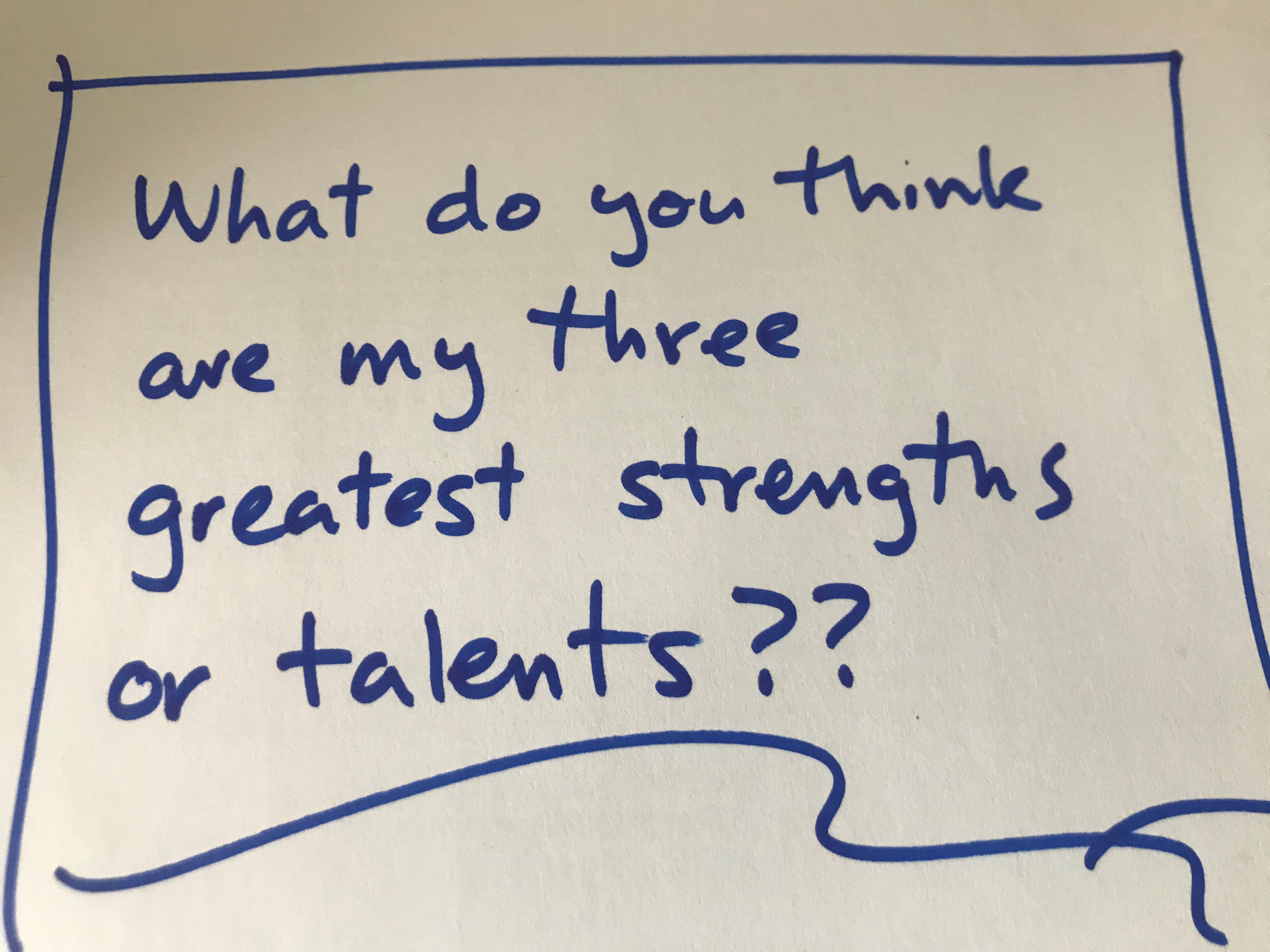
What do you think are my three greatest strengths or talents?
As you’re listening, be sure to ask the person for specific examples of each talent or strength. You can take notes if you’re comfortable, or just listen and then soon afterwards document what the person said about you—both your natural talents and examples to support them.
The purpose of this assignment is to get to know your personal strengths and talents from the perspective of others. Maybe you’ve done this sort of thing before. But because things change with time, it’s worth updating the feedback you get from others or worth asking new people for feedback.
At the end, write a summary of what you learned about your natural talents and upload it to Moodle for Dan and me to read.
Thanks and happy Friday.
John S-F
The place to click if you want to learn about psychotherapy, counseling, or whatever John SF is thinking about.




 John Sommers-Flanagan