Category Archives: Writing

The Morning of November 9, 2016

**This is only a semi-coherent first reaction to the Presidential election. Read if you want. Be aware that I channel a little Albert Ellis at the end.**

****************************************************

In four hours I’m supposed to teach a three-hour course on advanced theories of counseling and psychotherapy. The topic today is emotion-focused therapy for couples. It’s a good day to focus on emotions. I have more than a couple of them bouncing around inside me.

Maybe that’s why I made my way to a coffee shop at 5am this morning. That’s abnormal. But today is abnormal; the new abnormal.

Back in college a fellow student who was from Nepal explained to me the meaning of the greeting, “Namaste.”

“It means,” he said, “I salute the light within you.”

It’s a sad and painful morning. I’m not sure about the light in me. Instead, mostly I’m certain that yesterday and last night was a cosmic mistake. It feels like sexism, racism, and hate have triumphed over “. . . all men (and women) being created equal.” I feel this, even though I’m a White, heterosexual, Jewish-Christian-Agnostic male. Given my privileged status, it’s hard to comprehend the pain this vote has caused women and minorities.

But I can imagine it.

When I woke up to sounds on the street at 3am, my mind created evil agents of Donald Trump gathering outside my home to take me away. It was the sort of paranoid thought that can come in the night—even to those of us who are well endowed with safety and privilege. It makes me wonder if that what’s it like for my Lesbian, Gay, Transgender, Mexican, and Muslim friends and students?

Late last night I got a text from a wealthy White Christian man who described himself as in tears. “What’s happening to our country?” he asked. And then he wondered what he could tell his children in the morning. He had put them to bed with kisses and the anticipation that they would awaken to the first woman President in the history of the United States.

There’s too much pain and sadness and suffering in the world. But there was too much pain and sadness and suffering in the world last week. And there will be too much next week.

I hold vivid memories of suffering through Reagan’s election, and George H. W. Bush’s election, and George W. Bush’s election. Those were difficult times. In each case I was certain that an evil force on the planet had somehow made it possible for the less honest, less compassionate, and less competent candidate to win.

But this is worse.

Even so, I refuse to believe that the majority of Americans are sexist and racist. I see too much kindness. I hope that Donald Trump is only a temporary phenomenon. I hope his existence will motivate us to swing the pendulum back toward justice, kindness, and empathy.

I’m reminded of the alleged words of Jesus, “Forgive them father, they know not what they do.”

Somewhat irrationally, I still have faith.

I have faith in the possibility that, as Jesus said, many people do not know what they’ve done. I have faith that although Donald Trump won the vote, that most people are not inherently sexist and racist at their core. I have faith that we can reach out to, reason with, and love our enemies, even when they’re our neighbors.

I will also follow the advice that I give people for coping with crisis.

  • Take care of yourself.
  • Look around and do what you can do to take care of others, your family, your friends, and your community.
  • And, don’t do anything stupid.

After I woke up at 3 a.m. and shook off my paranoid thoughts of evil Trump agents outside my door, other words emerged.

“Don’t mourn.”

An old memory was knocking at my door.

“But I want to mourn,” was my response. “I want to mourn. I need to mourn. I want to feel the pain for myself, and for my community of friends and family who have had their hopes crushed.”

“Okay. The voice conceded. “Mourn briefly. Do not linger.”

I recognized that this message wasn’t necessarily mine or God’s. It sounded like Joe Hill, the old union activist. He was saying,

“Don’t mourn. Organize.”

Then I was up. I had my hour of mourning. It was 4am. The sun will rise. I will teach my class.

But more important, I will focus. I will organize. I will, in Freud’s words, “Sublimate my emotions.”

I will whisper “Namaste” to everyone I see. I will salute the light within them.

Even though, right now, it’s so fucking hard to see the light.


Professional Writing 101: Dealing with Rejection

This is how it goes.

You read, gather background information, do research, and carefully write a manuscript. You put in so many hours or days or weeks that you lose track of how much time you’ve put in—which is a good thing. You re-read, edit, get feedback, revise, and do your best to produce an excellent manuscript. You upload it a portal where it magically finds its way to a professional journal editor. Then, because you can only submit a manuscript to one journal at a time, you wait.

A month passes.

You keep waiting.

If you’re lucky, you hear back from the journal editor via email within two months. You click on the email with a mix of anticipation and dread. Then, ta-da, you learn your manuscript was REJECTED.

The editor is polite, but pointedly informs you that this particular journal doesn’t recognize the magnificence of your work. To add insult to injury, your rejection is accompanied by critiques from three different reviewers. These reviewers were apparently named by Dr. Seuss: Reviewer 1, Reviewer 2, and Reviewer 3.

Some rejections are worse than others. Maybe it’s because your hopes were too high; or maybe it’s because the journal’s impact factor rating was so low. Getting rejected when the journal has an impact rating of “0” can bring down your self-esteem to a similar level.

And then there are the reviewers.

It’s important to remember that reviewers are busy, fallible, human, and unpaid volunteers. They’re also purportedly experts, although I’ve had experiences that led me to question their expertise. Many appear to have a proverbial axe to grind. Perhaps because they experienced scathing critiques in their professional childhood, they feel the need to pass on the pain. Sometimes they just seem obtuse. I’ve wondered a time or two if maybe a reviewer forgot to actually read the manuscript before offering an off-point “review.”

If you sense bitterness, it might be because over the past several years I’ve experienced an extra-large load of rejections. When the New England Journal of Medicine (NEJM) rejected my manuscript in less than a week, I was disappointed. But because the NEJM is the most prestigious journal on the planet, I didn’t linger much on the rejection, because rejection was expected. But when a decidedly less-prestigious professional group rejected all my proposals to present at an annual conference, I was deeply hurt, saddened, and angry. Reading the reviewers’ comments didn’t help.

At one point last summer, in a fit of self-pity, I decided to count up my two-year rejection total. I got to 20, had a flash of insight, and stopped. It was like counting cloudy days. My advice: Unless you’re especially serious about depressing yourself, don’t count up your rejections. If you’re into counting, put that energy into counting the sunny days.

One time, back when I was immature and impulsive, I received an insensitive and insulting rejection from a low tier journal. My response: A hasty, nasty, and indignant email lambasting the editor and his single reviewer for their poor decision-making process and outcome. Sending the email was immediately gratifying, but, like many immediately gratifying things, not reflective of good judgment. I never heard back. And now, when I see that editor at conferences, it’s awkward.

More recently, I responded to a rejection from a high-status conference with humility along with a gentle inquiry about re-consideration. Less than 24 hours later they discovered “one more slot” and I was in! It was a paid gig, for an excellent conference, and at a convenient venue. Bingo. Let that be a lesson to me.

Last month I received a different sort of journal rejection. It was an invitation to “Revise and Resubmit.”

Put in romantic terms, revise and resubmit is lukewarm and confusing. The message is, “I kind of like you, and you have potential, but I’m not ready for a commitment.” But if you’ve been casting out and reeling in a raft of rejections, revise and resubmit is a welcome flirtation.

I had submitted a manuscript focusing on suicide risk assessment to a reasonably good journal. It was a good manuscript. In fact, Reviewer 3 recommended publication. But Reviewer 1 spoiled my day by offering 23 substantial and picky suggestions. The editor, who wrote me a long and rather nice email, decided to go with Reviewer 1’s opinion: revise and resubmit.

Given that I’ve been reviewing the suicide risk assessment literature for a couple decades, I assumed I was well-versed in the area. But when I read through Reviewer 1’s suggestions I was surprised, humbled, and eventually pleased. Reviewer 1 had many excellent points.

Looking back and forward, I think this is what I like best about submitting manuscripts to professional journals. Basically, you get a free critique and although some reviewers are duds, others are experts in the field who provide you with a fabulous educational opportunity. There’s always so much more to learn.

The moral of this story and blog post is that the attitude we have toward rejection is far more important than our fragile egos (at least it’s more important than my fragile ego). In response to the revise and resubmit verdict, I’ve graciously accepted the feedback, engaged a co-author to help me, and we have now systematically plowed through the 23 recommendations. The result: Last week we re-submitted a vastly improved manuscript.

Now we wait.

Although I have hope for success, I also realize that Reviewer 1 may have a bit more educational feedback to offer. But this time around, I’m looking forward to it.


OLYMPUS DIGITAL CAMERA

What Brain Science Says about Becoming a Better Professional Writer

This piece on professional writing is in anticipation of our upcoming John Wiley & Sons sponsored ACA presentation on April 1 in Montreal titled: Writing for Publication: Insights and Strategies

The “Decade of the Brain” started way back in 1990. It’s been over for more than 15 years. So you would think everyone could get over it and move on. But obviously that’s not how things pertaining to the brain work. Too many neuroscientists, journalists, and other people are happily riding along on the brain science bandwagon to just let it go. Most things would be perfectly satisfied with their own decade and the attention that goes with that, but the brain is a selfish organ and obviously interested in hogging all the decades. And so the brain discoveries just keep rolling in and eager journalists keep on writing and talking about the brain, which is why the popularity of neuroscience is now officially off the map. Neuroscience’s reach has far exceeded its grasp, but such is the nature of popular things. Just think about bell-bottoms.

We still know very little about the brain. That’s partly why neuroscience excites people. The excitement is more related to our collective brains collective imagination of what neuroscience might be than neuroscience reality. This has turned neuroscience into a projective test (think of the Rorschach Inkblots). There’s some vague information or structure out there and so everyone takes some of it in, blends it with their unique personality and past experiences, and then projects hypothetical possibilities about brain science onto the blank canvass of reality. Then voila, people start talking about ridiculous things like male brains and female brains and teen brains.

I say all this as a balancing introduction that will help me not sound completely trite and ridiculous when I write,

Coming up next: What brain science says about how you can become a better writer.

Let’s pause and self-reflect here. This statement is both bad writing and bad science. It’s bad writing because I’ve transformed (through grammatical magic) the inanimate field of brain science into an entity that has something to say. It’s bad science because the first rule of becoming a better writer, although supported by neuroscience, is such numbingly basic common sense that it’s inappropriate to gift it the charade of scientific authority.

Put another way, brain science can’t talk; people talk. But if brain science could talk, and you asked it, “What can I do to become a better writer?” it would likely respond with something like:

The first rule to good writing is WRITER’S WRITE. This is what literary and professional writers have said over and over for centuries and you didn’t need me, brain science, to tell you something you already knew. (see also: https://johnsommersflanagan.com/2013/09/04/professional-writing-for-us-professionals-who-may-not-quite-be-writers-yet/)

If there’s one thing we know from brain science (and common sense), it’s that practice leads to improvement. Neuroscientists might say it this way, “Your behavior directly influences your brain structure and chemistry; when you repeatedly practice something, you’re actually creating specific neurons and neural pathways to make that something easier.” Common sense (if it could talk) might say, “Repeated practice generally leads to skill development.” Speaking (apparently) on behalf of common sense, the renowned science fiction writer Ray Bradbury wrote:

Just write every day of your life. Read intensely. Then see what happens. Most of my friends who are put on that diet have very pleasant careers.

The take home message here is simple. If your goal is writing success, then you must make time to write.

There is, of course, a caveat to this general brain-based common sense rule. Yes, practice leads to improvement, but there are always exceptions.

Sometimes, even when you practice with great effort, consistency, and sincerity, you don’t improve much. The good news about this exception is that in the world of writing there are usually fascinating reasons for why diligent writers aren’t improving . . . and I’ll get to that important content at some point in the future. For now, remember this: The first step to becoming a successful professional writer involves taking Bradbury’s advice—which I repeat and elaborate on below:

  • Write every day
  • Read intensely
  • Get feedback
  • Engage in self-editing—produce a 2nd, 3rd, and 4th draft
  • Schedule more time to write
  • Identify your target audience and then learn more about them
  • Deal with multiple distractions
  • Reward yourself
  • Get more feedback so that you can be certain that you’re not rewarding yourself when you should be engaging in more self-reflection and scrutiny
  • Read your 4th draft aloud to yourself, then read it aloud to someone you trust to get even more feedback
  • Find somewhere to submit your precious manuscript
  • Hope for the best, but prepare for rejection
  • When you get your rejection, stay calm and integrate the feedback into your writer-identity
  • Revise your manuscript again, read it aloud again, get feedback again
  • After dealing with your neuroses, improving your manuscript, and gnashing your teeth, find the courage and strength to face your fears and resubmit your precious manuscript to somewhere that will recognize its greatness
  • Hope for the best, but prepare for rejection—again
  • Repetitively do all these things to help your brain structure and chemistry develop itself and you into a better writer who has a better chance of writing success

Before moving on I should say that I realize Bradbury was advising fiction writers and fiction writers fall within the literary writing domain. This is an important distinction. If you’re reading this blog, you’re probably busy juggling numerous professional activities. These activities might include a combination of teaching, research, service, attending classes, clinical practice, supervision, and more. Traditionally, writers with literary ambitions only juggle their daily writing and reading with a job delivering pizza or waiting tables. It’s likely that you have a more rigorous and full professional life. This is one good reason why your immediate goal shouldn’t be to publish your first novel or personal memoir. You probably don’t have time for those more ambitious goals; most human services professionals who write novels and memoirs do so during sabbatical or after retirement. For now, our goal for you and your goal for yourself should be to begin taking small steps toward becoming a professional writer. The best-selling novel will have to wait.

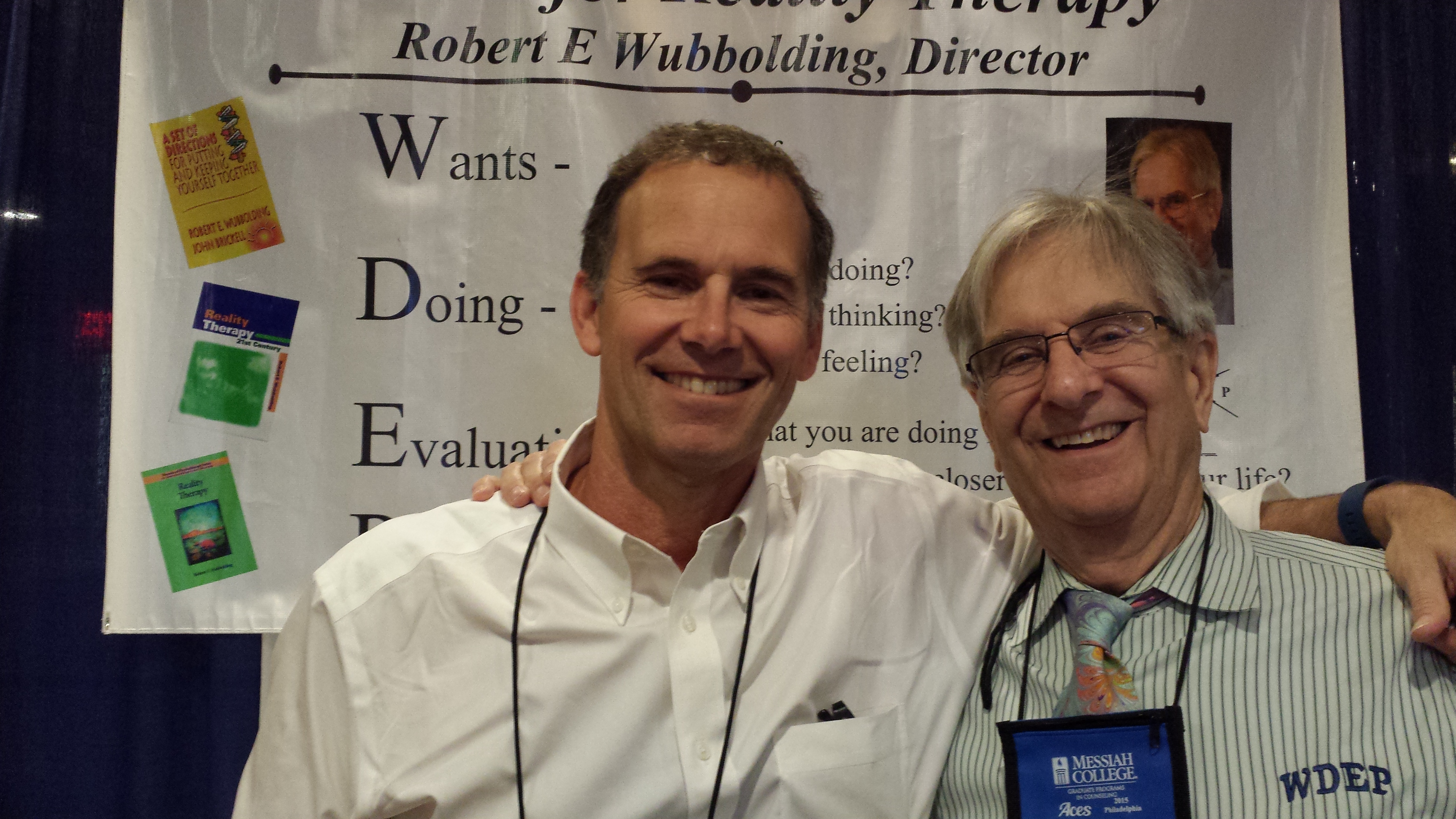
John hanging out with Robert Wubbolding

With Wubbolding

Neuroscience New Year’s Resolutions for 2016

In case you forgot or never knew, 1990 to 2000 was championed as the decade of the brain. You would think one decade would be enough, but judging by how much of a darling neuroscience is in the media, it looks like the brain will be hogging the whole 21st century too. And so in celebration of our perpetually “New Brain Science,” I’m offering six neuroscience-based New Year’s resolutions for 2016

1. For years, the Dali Lama has been advising everyone to develop a “Loving Kindness” meditation practice. Even if his advice doesn’t change the world, having a consistent loving kindness meditation practice can change your brain. Mindfulness meditation strengthens a region in the brain called the insular cortex, an area broadly linked to self-control and good judgment. This makes 2016 a good time to start meditating. We could all use a little more self-control and good judgment.

2. You should sit down for this one. Or stand up. And then sit down again. This is because scientific research supports brain-body connections. Exercise facilitates everything from sleep to sex. If you want a sharper brain for 2016, then stand-up and get walking or stretching or running or lifting or dancing your way to clearer thinking.

3. Last year might have been the year of the gut. There’s been plenty of talk about the “gut” being our second brain. Of course, this isn’t about growing your gut or striving for a dad-bod. It’s all about digestive health. The best way to get your second brain to support your mental health is to feed it whole, fresh foods, probiotics, and fermented foods (like kombucha, sauerkraut, and kimchee), while avoiding the evils of eating highly processed white sugar/white flour.

4. Exercise is great and good sex may be better, but loving and gentle touch is the bomb. Make 2016 the year—not only for consensual hugs and kisses—but also for shoulder and neck and foot massages. You can even put brushing each other’s hair on your “this-just-might-improve-my-mental-health” to-do list.

5. In 2015 sleep research was hot. It’s more obvious than ever that sleep deprivation is generally bad for your brain; it contributes to clinical depression, suicide, accidents, and illness. Finding a way to sleep well in 2016 means turning off your screens at least 30 minutes before bedtime, cutting out the caffeine after 2pm, and establishing a steady personal and family sleep routine. Sleep is the new black.

6. For those of us in the helping professions, the biggest neuroscience news is all about what psychotherapists call empathic listening. Turns out, listening in an effort to understand others grows the brain in ways similar to mindfulness meditation. That means the more you practice listening with empathy, the more you’ll grow that all-important insular cortex . . . and the more you grow your insular cortex, the less likely you are to engage in violent behaviors that threaten the planet. So if you want a more peaceful planet, put empathic listening on your New Year’s resolution list.

There’s one big principle that underlies all of the new brain science: Whatever behaviors you rehearse, practice, or repeat, are likely to strengthen your skills and grow your brain in those particular regions. What this means is that if your goal is to be a couch potato for 2016, you should spend lots of time couch potatoing so you can develop mad skills in that area, with a neurological net to match. On the other hand, if you want a healthy brain and body and awesome friendships and romance in your life, you should engage in the activities listed above—especially the mindfulness meditation and empathic listening—and you’ll grow a brain and skills that just might bring health, love, and peace in 2016.

Note: I submitted this awesome resolution list to a couple newspapers just before the New Year, but only got rejections. And so I decided to submit it to myself and, voila!, it got published right here on my very own blog (smiley face). Please share and pass it on so that all the newspaper editors who keep rejecting my work start feeling the deep regret they deserve.

Outstanding in Field


Writing about Writing . . . Feedback Please?

Over the past several days I’ve been inspired to pursue a new project that focuses on writing about professional writing. This is the sort of thing that happens to me when I’m facing a big list of imposing writing projects . . . I decide to add one more.

But the good news is that I’m having fun and producing lots of words on this topic. My latest method for generating words is to go for a long walk with my cell phone. Then, I dictate email messages to myself through my cell phone and send them. Pretty cool. Over the past two days I’ve “written” almost 8,000 words.

There are some problems with this system, however. In particular, if there’s any wind, or if I don’t enunciate perfectly, my phone is inclined to misquote me. The result: In the moment I feel exceptionally articulate and then I when I get home and read the emails I’ve sent myself, I sound somewhat less articulate. Here’s an example:

1 thing keep in mind is: your trickster is not my sister. What is means is that are in your obstacles 4 demons are unique to us as individuals. You wear the standard prescription for all riders. Beware the single strategy you overcome writers block. He wear even if we say it, love 1 message to manage your picture.

You can imagine my disappointment at receiving this message from myself, I’m sure. If that preceding paragraph wasn’t absolutely hilarious, I might be furious at having lost whatever profound message I was trying to communicate with myself. But I have to say that reading these emails from myself makes for excellent entertainment.

This reminds me of a dream I had back in grad school. It was amazingly profound . . . but I’ll skip that and get to the point of asking you for feedback.

If you’re a current or recent graduate student, please send me your answer to one or more of the following questions:

1. What emotions and thoughts do you experience when you turn in a paper to a professor (or, better yet, a thesis or dissertation committee)?

2. When you get lots of “constructive feedback” what thoughts and feelings do you experience? This might involve you receiving a paper back with a low grade and/or lots of “red ink.” Can you share an example of what you think or feel in response to that situation?

3. When you get positive feedback, what thoughts or feelings does that trigger? Can you share an example?

4. After you’ve gotten negative or constructive feedback, how do you find the strength or courage to send in another draft or turn in the next assignment?

If you’re currently a professor somewhere, consider answering one or more of the following:

1. What thoughts or feelings do you have to deal with to get yourself to write something?

2. How do you react to or deal with rejection? For example, if you have a manuscript or proposal rejected, what do you say, do, think, or feel? What do you do to “bounce back” from rejections of your written work?

3. How do you react to success? For example, when you have a paper accepted or get positive feedback, how does that affect you?

4. What helps you write well . . . or in what situations are you likely to write efficiently.

Thanks for thinking about this with me. I appreciate it. And I’ll even appreciate it more if you send me an email answering some of the preceding questions. Send it to: john.sf@mso.umt.edu

And . . . I’m confident that whatever you send me will arrive in better shape than the emails I’ve been sending myself.

2014-06-03_15-45-11_474

My Adams State University Chi Sigma Iota Initiation Speech

It’s an honor to be here on this excellent almost-spring-day in Alamosa, Colorado. Thanks to Jazmin, Chris, and Lori for inviting me here and arranging this visit. I’m so touched about this that I wrote a song especially for this event. And so you’ve got that to look forward to.

When it comes to giving speeches and workshops, one of my former professors used to say this: If you ask me to give a 15 minute talk, I’ll need all day to prepare; if you ask me to talk for a couple hours, I’ll likely need a couple hours of prep. But if you want me to talk all day . . . I’m ready.

This is why I have some verbatim notes here. Tomorrow I’ll be talking all day and therefore be way more spontaneous. Today, I need a guide to keep me focused.

The first thing I’d like to report is that the profession and discipline of Counselor Education is doing well . . . and maybe even booming. Just last night at the University of Montana we held our live group admissions interview for our CACREP-accredited Clinical Mental Health and School Counseling M.A. Programs. We have a total of 18-20 openings for these degrees and 71 applicants. About 45 applicants showed up for a 2 ½ hour group interview. After the interview, late into the night, we were discussing the applicants and one of our current students who was helping with the process exclaimed, “Thanks for letting me be a part of this. This was like Fantasy Football in February.” We took that as a compliment.

This is why I LOVE being a Counselor Educator. I don’t love it for the Listserv, or the ACA convention, or the status and prestige of being a Counselor Educator and teaching at the University of Montana. I love it because every year I get to spend most of my time teaching the kindest and most respectful graduate students on the planet; students who are deeply committed to helping others and to making the world just a little bit better place for individuals, couples, families, groups, schools, and communities. I have the honor of teaching these great people and maybe partly because we teach them how to have awesome listening skills, when I teach, they actually look like they’re listening to me. This is the best job ever.

And so thanks for letting ME be a part of THIS Excellent Day and CSI Induction Ceremony. It’s definitely better than fantasy football in February.

What I hope is that this is not just an initiation ceremony . . . it should also be a celebration . . . which brings up an important question: “How shall we celebrate?”

Well, of course, there should be dancing . . . and singing . . . and maybe some slam poetry . . . and of course, high fives all around, and arms raised in the air, and clapping and cheering (woo hoo) and toasting and smiling and laughing and eating desserts. Let’s do it all!

Counseling is a profession and identity that comes from the people. From way back in 1909, with Frank Parsons publishing “Choosing a Vocation” (with Pauline Agassiz Shaw’s unwavering financial and emotional support), it had become clear that modern citizens from the early 20th Century could benefit from assistance in making important decisions.

Think about that. Where do we learn to make decisions? Not just decisions about vocation and career, but other important life decisions? Did your parents explicitly teach you? Did you take a “Decision-Making” course in high school or college? Did you enroll in a life decision-making workshop? Probably not. Sometimes I think it’s mostly only in graduate school where Counselor Education students get taught how to make decisions and how to help people make important decisions.

This is still a big part of what we, as counselors, do. We help people make everyday life decisions. We help them sort through the thoughts, feelings, impulses, and social and cultural forces that make decision-making so challenging. And we help them make bigger decisions too.

Counseling is a profession with roots back in the early 1900s with Frank and Pauline, but professional counseling is a much more recent development.

Not long before Thomas Sweeney of Ohio University founded CSI in 1983, it was becoming apparent that Psychiatry, Psychology, and Social Work weren’t adequately serving the needs of all the people. In the 1960s and 70s, Psychiatry was mostly taking the BIG PHARMA road, Social Work mostly linked hands with Medical professionals, and Psychology mostly decided to embrace Ph.D.-only training, a sort of scientific fundamentalism, and the pursuit of becoming mini-physicians.

IMHO, this was a mass exodus from the needs of most people. Helping became much more about the medical model – assessment, diagnosis, and treatment – and less about helping people achieve what most of us really want in our daily lives, good health and positive wellness.

So there was something big missing. People wanted to work with professional practitioners who were empathic, kind, compassionate, and positive, and interested in helping them feel WELL, instead of just helping them not feel sick. This is the breech into which professional counseling stepped. And this is probably why, in a study conducted in the Psychology Department at the University of Montana in 1991, it was reported that consumers rated Counselors as warmer, kinder, more genuine, and more desirable to see than Psychiatrists or Psychologists.

At the University of Montana we have an MSW, a Clinical Psychology, and our Counselor Education graduate programs. Not surprisingly, we have a bit of a friendly competition for graduate students. Don’t get me wrong, I love my colleagues in Psychology and Social Work and I think they do a fantastic job educating their students; I just think their professional disciplines have gotten drawn a bit too far over into the medical model. Consequently, when prospective students ask me what program they should choose, I find it very easy to say, “If you want to learn how to do, I mean, really how to do individual, couple, family, and group counseling, then you should join us in the Department of Counselor Education.” Even the graduate students in these respective programs recognize that Counselor Education students learn these skills faster than other disciplines . . . principally because that’s what we focus on.

This brings me to some concerns for the future.

There will always be medical creep, pharmaceutical creep, and insurance company creep. The medical model is strong and compelling. We have to watch out for that. For example, right now we’re right in the middle of a Neuroscience party that’s dominating popular discourse. This reminds me of a Psychiatrist with whom I worked at a Psychiatric Hospital back in 1981. He said it wouldn’t be long until we were all taking drugs to manage and moderate our emotions and behaviors. Well, mostly he was wrong.

Now we have “brain-based” this and “brain science” that and to be “in the dominant cultural discourse club” we have to put “neuro” in front of every other word or sentence.

But there are some surprising ways in which the medical model and neuroscience don’t provide much guidance or truth.

There’s really no such thing as a chemical imbalance. If you speak Spanish and I don’t, then our unique brains have to be different. The chemical imbalance as an explanation for mental health problems has no particular scientific support.

In addition, the track record of psychiatric medications curing illness is rather abysmal. I’m not saying that medications never work, I’m just saying they work less well than most of the public has been led to believe.

And the majority of the quantitative research published in psychology journals is, to borrow Carl Rogers’s words from 1957, “for the most part, a colossal waste of time.”

My point here is: Let’s be damn good professional counselors, and not try to be like those other professional disciplines. They have their niche; they’re needed in some ways for some things. But let’s stick with what we’re doing well.

As I’m sure you all know, because I don’t have a portable MRI or PET scanner in my office—which wouldn’t allow me to really “see” what’s happening in someone’s brain anyway—there’s really only one good method for me to know what’s going on in my client or student’s brain.

The best way to do this is to sit with the person and listen well and develop a trusting relationship and ask things like:

• What are you thinking right now?
• What do you want?
• What emotions are coming up for you?
• What feelings and sensations do you have in your body?

Being with people in positive therapeutic relationship and sometimes asking no questions at all, is the best brain scanner we’ve got.

And here are a few more important truths:

1. A pill is not a skill
2. There’s no better medicine than a healthy and caring relationship, and
3. The profession that is currently doing the best at focusing on skills and relationships is Counselor Education!

As the EMDR therapists would say, “Let’s go with that.”

Before ending, I’d like to tell one short story; then we can officially start celebrating.

Meeting Jesus at the Portland VA Story: What this psychotic patient wanted and what he responded to was what most of us want and respond to . . . to be listened to . . . and to be treated with respect and as an individual, not as a psychiatric label.

Now let’s begin our official celebration with a song that I wrote especially for this auspicious occasion. Ready? I’ll sing it through first and then you can all stand if you like and join me:

Oh, I wish I were a counselor-in-training, counselor-in-training . . .
I think it’d be rather swell
To help everyone be well
Oh, I wish I were a counselor-in-training, counselor-in-training.”

Everybody now . . .

Thanks for listening and my BIG congratulations to all of the initiates and the faculty here at Adams State University.

Neuro-counseling or Neuro-nonsense: You be the judge

This is a Book Review written by a current doctoral student, Tara Smart and John SF. It was published this past June in the online journal, The Professional Counselor: http://tpcjournal.nbcc.org/

As you may detect, Ms. Smart and I are circumspect about the neuroscience bandwagon.

Here’s the review:

In A Counselor’s Introduction to Neuroscience, the authors claim that “neurocounseling” is the fifth force in the history of psychology and counseling. Although a precise and detailed definition of neurocounseling is elusive (both in this book and in the professional literature), it is described as the marriage of counseling and neurobiology. They offer a crash course in brain anatomy, function, and development in order to lay the groundwork for how neurocounseling can be used effectively with clients. Several chapters focus on the ways the brain is affected by certain mental disorders, and how specific counseling approaches address various brain regions and functions. The remainder of the book focuses on assessment of brain function and fictional cases to illustrate neurocounseling techniques. The chapters include numerous tables, figures, cases and opportunities to stop and reflect. The overall intent of the book is to arm counselors “with yet another highly effective and efficient way to help clients cope with (overcome, etc.) their personal psychological distress.”

Although the authors are clearly enamored with the interaction between neurobiology and counseling, they purposefully offer honest words of caution regarding the nascent and speculative nature of contemporary brain science. However, on occasion, they also make promising statements without citing scientific evidence and generalize results from animal studies (including rodents) to humans without offering their reasoning for doing so. As with any other resource, practitioners are responsible for weighing information and evaluating whether it is accurate and whether it will be helpful in their work. It is important to note that this book bills itself as an “introduction”—readers should not expect concrete or realistic examples of how professional counselors can use their new neuroscience knowledge to understand and enhance client functioning.

A Counselor’s Introduction to Neuroscience will help counselors begin to grapple with the implications of neuroscience for our profession. Although the neuroscience knowledge base that the authors provide is a good start, scientific rigor in terms of concrete application would be useful. Years from now, neurocounseling may well be a new force in counseling, but presenting it to the counseling community as an effective and efficient way to help clients today is premature. In the end, it is best to consider this book as a reasonable beginning and food for thought rather than a how-to guide for counselors seeking neurocounseling training. Hopefully in the ensuing years, there will be clearer guidance available to help professional counselors integrate neuroscience into their practice.

John using his Star Trek tricorder (cell phone) to do a quick selfie brain scan. The results were not promising.

2014-06-03_15-45-11_474

A Little Something I’ve Been Writing

Occasionally, against my better judgment, I (John) log into and read discussion boards in various online venues. These venues include sites where the public is invited to comment on newspaper or magazine articles, blog posts, books, and videos. Even worse than reading these discussion boards, I sometimes experience powerful emotions, emotions that draw me to the keyboard and into an internet discussion or debate. When I read something I find provocative or offensive, it can be very difficult to stop myself from commenting. But if I control this urge, after a few minutes, hours, or days, the impulse subsides and I’m then enlightened as to why my initial impulses to deliver a quick and clever retort were misguided. It also helps when I consult with wife on what it is that I’m wanting to write. Her sarcastic analysis of my juvenile impulses helps me inhibit my desire to make a fool of myself.

But there are times when I don’t wait long enough. And there are times when I don’t consult my wife. Instead, I channel the emotion I’m feeling (usually anger) into what I consider, in-the-moment, to be a pithy, clever, or creative retort.

Flaming

The online world has a name for this phenomenon; it’s called flaming. Flaming is defined as a hostile and insulting interaction in an internet forum or discussion. It may include profanity and name-calling. I like to think I never stoop quite that low. Some internet users are intentional flamers who comment on specific topics in an effort to inflame or incite; others, like me, are occasionally drawn into an internet brawl.

In June, 2013, while perusing books about boys and male development, I came across the book: Raising Boys Feminists will Hate by Doug Giles. If the title of the book was a spark, the first page fanned my fire. Giles opened with:

Parent, if you have a young son and you want him to grow up to be a man, then you need to keep him away from pop culture, public school and a lot of Nancy Boy churches. If metrosexual pop culture, feminized public schools and the effeminate branches of evanjellycalism lay their sissy hands on him, you can kiss his masculinity good-bye because they will morph him into a dandy. (p. 1)

In this case, I could have taken a few deep breaths and waited. There was no hurry for me to respond. Why not wait? It also would have been advisable for me to consult my wife. But what fun would that have been? I knew what she would say. I also knew that instead of self-control or restraint, at that moment, mostly I wanted immediate gratification. Such is the nature of contemporary internet flaming. It’s about instant gratification; it’s not so much about thoughtful and reflective discourse. So, before I could fully contemplate my actions and while avoiding contact with anyone who might push me toward a more mature perspective, I quickly wrote a short book review:

This guy clearly has an ego of immeasurable proportions. I think the main problem is that he’s deluded himself to believe that just because he said it or wrote it, it must be true. I’m not sure anyone in the mainstream is against raising boys to be strong men with good character. But I suppose he’s just creating the image of Nazi-feminists so he can blast away at them and consequently increase his media attention. The real title of this book should be: “I hate feminists and because I’m a real man who knows everything, you should too.” I’d like to challenge him to a debate on Fox, but I’m afraid I’d lose control and get into fisticuffs and consequently damage my sissy-feminist reputation.

In retrospect, I see that this wasn’t my greatest moment. When I start a commentary with “This guy. . .” whatever follows isn’t pointed in the direction of intellectual sophistication. And when I deteriorate into mentioning “fisticuffs” well, then it just becomes a process of embarrassing myself.

Fortunately, I was posting on a relatively “quiet” discussion board. The first response to my post didn’t come until months later. Here’s a clipped version of what a person with the online handle “Jeffery Bozo” had to say about Giles’s book and my review of his work:

The Feminists stayed at the party too long and now they are just beating a dead horse. It’s time for them to find another hobby.

Doug’s comments concerning the Feminist takeover of education are spot-on. 90% of public school teachers are female and/or gay. Does that sound diverse and balanced to you? It seems these activists only concern themselves with their diversity pie charts when it favors their natural enemies. Sounds like female-Femi/Stasi-pigs to me. The height of hypocrisy.

What I took from Mr. Bozo’s post was that he was apparently unimpressed with my clever book review. And although much of what he wrote didn’t make any sense to me, I can see why he, and many others, might take offense to what I wrote. I was neither fair nor balanced. I didn’t focus on the book’s content. I was mocking and insulting Giles and his work. Even though it felt clever and gratifying in the moment, it wasn’t helpful or constructive (both of which are more valuable in a book review than offering clever insults).

You may want to come to my defense. After all, Giles was being intentionally provocative in his choice of book title and his opening paragraph. One great way to deny personal responsibility for immature behavior is to claim: “He started it!” And, although there’s truth to that, Giles’s being provocative is no excuse for my flaming response.

Interestingly, a few months later, another reader decided to enter into the discussion and share her feelings. Her post was directed to Mr. Bozo:

Wow, you are a truly special breed of stupid and ignorant, aren’t you? Your last name is perfectly fitting, because you’re a clown.

When this comment initially popped into my email I had the horrific thought that the posting was about me. Although I was relieved to discover that the commenter was on my side and referencing Mr. Bozo, this is still an excellent example of destructive flaming.

Here’s the main point: Flaming responses, whether online or in-person, nearly always have the intent of “teaching someone a lesson” or “putting someone in his or her place.” And here’s the corollary: It doesn’t work because the other person doesn’t want to hear the lesson and doesn’t want to be put in his or her place.

Confirmation Bias on My Way to Spearfish, South Dakota

Confirmation bias is an insidious cognitive process that typically travels just below our awareness. Here’s how it worked for me today.

I’m on my way to Spearfish, SD to do a “Tough Kids, Cool Counseling” workshop tomorrow and keynote on Friday. My belief is that it’s always hard to pack up and get everything ready and make it to the airport. Usually I hold a negative confirmation bias in my mind. This negative bias involves a belief or working hypothesis that the world will conspire against me and stress me out in the process of trying to arrive at the airport in a timely manner.

First, I’m in my office and about to turn off my computer and my office phone rings. Rarely does my phone ring anymore and it’s even more rare that I answer it with only 10 minutes left before my pre-planned office departure time. But my impulses take over and I answer it. It’s the associate dean and our development officer wondering if I have a few minutes to talk. They rush down and we meet for a few minutes, which puts me only slightly behind as I head to the copy machine for, of course, some last minute copies.

Second, Rita is driving me to the airport. She asks me what route she should take (please note: Rita almost never asks ME what route to take and so this is an anomaly in and of itself). I rise to the bait and tell her my quickest route to the airport.

Third, my best route to the airport begins crumbling when we have to stop for a train.

Fourth, my best route has a back-up option in case of a train. We take it. It leads us directly into road construction.

Fifth, we circumnavigate (I love that word) the road construction and make it to the airport.

Sixth, my confirmation number is in a “pre-check-in” email on my cell phone. I pull out my phone and sort through 53 emails, twice, before concluding that it has apparently disappeared.

Seventh, I get checked in anyway and head through security and upstairs only to discover that Liquid Planet’s espresso machine is broken and I can’t have my pre-flight white chocolate mocha and . . .

Eighth, I have to drag my bags and myself downstairs to use the restroom because the road construction has taken over the upstairs airport bathroom.

But now I’m here, sitting and waiting to board my flight and marveling at how today, for some odd reason, I was able to monitor the universe’s push-back and yet not get sucked into a bad mood. Of course, given that I saw the confirmation bias coming, I was able to simultaneously notice the universe’s positive encouragement as well. After all:

1. The associate dean and development officer are two of the nicest people on the planet and they wanted me to speak at a fancy College of Education and Human Sciences event and that sounds like fun.
2. The copy machine worked perfectly and there was NO LINE!
3. It was a beautiful, sunny day in Missoula as I bicycled back and forth from the University on my perfectly functional bike that didn’t get a flat tire.
4. Rita shared half an avocado with me while at home.
5. The toilet flushed without incident.
6. The car started without incident.
7. The circumnavigation went well and it reminded me of how much I like the word circumnavigation. I was also reminded that Rita is an excellent driver and stupendous conversationalist.
8. The guy at the United Airlines desk was nice and efficient.
9. I got to be in the TSA pre-screening category (not that it makes any difference in the Missoula airport).
10. Instead of getting a white chocolate mocha that I didn’t need I got exercise on my way to and from the restroom.
11. I still got here in time to write this post.
12. And, I’m on my way to Spearfish, South Dakota to have an excellent time with some cool professionals who have dedicated their lives to helping others.

Seriously, it would be difficulty to conclude, despite my usual negative confirmation bias about trips to the airport, that this day (and perhaps my whole life) is anything other than infused with most excellent good fortune.

I wish you all the best with your own confirmation bias challenges. Your homework assignment is to intentionally count the positive events in your life and intentionally not count or dwell too much on the less-positive events.

The Active Voice in Writing: An APA Style Blog

[OPENING SENTENCE #1] One challenging grammatical maneuver in contemporary writing is the proper use of the active voice.

Oops.

Because this essay is about the active voice, it might be a better idea to use a more active voice for the opening sentence. What do you think of the following alternative?

[OPENING SENTENCE #2] Proper use of an active voice is a challenging grammatical maneuver in contemporary writing.

Can you see or feel the difference in these two opening sentences?

Although the use of the word maneuver is a questionable choice in both sentences, an active voice is better illustrated in the second opening sentence. That’s because “active voice” is the subject and “challenging grammatical maneuver” is the object or outcome that an active voice acts on.

I think.

Editors, publishers, and even the 6th edition of the Publication Manual of the American Psychological Association advise neophyte writers to eschew the passive voice. They also suggest eschewing words like eschew and neophyte, but that’s another topic altogether. For now, we are admonished to use the active voice. The Publication Manual also encourages prospective APA authors to use first-person language to promote clarity. I like that.

But what exactly is the active voice?

The active voice involves a subject acting on an object. For example, “She is depressed,” includes a subject “She,” a verb, “is,” and an object or outcome “depressed.” An active voice involves arranging the sentence in a way so that the subject acts on the object. Another example, “Depression crept into him” illustrates how, in some cases, it’s possible to anthropomorphize or animate an entity so that it becomes the actor and what you might usually consider the subject becomes the object that is acted upon. This is a good example of flexibility and creativity in writing, but a less good example of an active voice.

Here’s another (and clearer) example that you might find in a research paper:

“The researchers reported insignificant results.”

In this case, “The researchers” are the subject and they’re taking the action of reporting insignificant results.

Many writers find it difficult to use or maintain an active voice. The passive voice may feel easier or more natural and therefore be used when the active voice would be more clear and succinct. Here’s the passive voice version of the preceding example:

“Insignificant results were reported by the researchers.”

Note that although the passive voice is factually correct, it’s less parsimonious and less direct and therefore less desirable.

Grammar Girl is a good source for more active and passive writing examples [you can listen to her grammatically correct and calming voice at: http://www.quickanddirtytips.com/education/grammar/active-voice-versus-passive-voice?page=all#sthash.Ys1GOZN9.dpuf]. Here’s what she has to say:

A straightforward example is the sentence “Steve loves Amy.” Steve is the subject, and he is doing the action: he loves Amy, the object of the sentence.”

Another example is the title of the Marvin Gaye song “I Heard It through the Grapevine.” “I” is the subject, the one who is doing the action. “I” is hearing “it,” the object of the sentence.

In passive voice, the target of the action gets promoted to the subject position. Instead of saying, “Steve loves Amy,” I would say, “Amy is loved by Steve.” The subject of the sentence becomes Amy, but she isn’t doing anything. Rather, she is just the recipient of Steve’s love. The focus of the sentence has changed from Steve to Amy.

If you wanted to make the title of the Marvin Gaye song passive, you would say “It was heard by me through the grapevine,” not such a catchy title anymore.

Grammar Girl also noted on her podcast that sometimes writers (or speakers) intentionally use a passive voice, or at least a neutral voice. This resulted in the following examples in our University of Montana class today.

This wall is painted (neutral voice).

The painters painted this wall (active voice).

This wall was painted by painters (passive voice).

As you can see from these examples, identifying an actor (or subject) in a sentence may or may not be important or relevant. Grammar Girl also used the example of President Ronald Reagan’s famous “Mistakes were made” line. She noted that, for obvious reasons, sometimes politicians (or others) want to be vague about assigning linguistic responsibility to a specific actor. The more active voice alternative might have been: “I made mistakes.”

Finding your active voice and avoiding a passive voice requires awareness, practice, persistence, and motivation. To help with this process, I have a few tips you might want to try out.

  1. Watch out for the word “by.”

Both of the passive voice sentences in Grammar Girl’s examples included the word “by.” This is often the case. You might remind yourself of this tip by using the following self-statement [Can you reword this sentence to make it more active?]: “I’m going to say bye to by.” Or—even better—you might use the preceding self-statement to remind yourself of this tip (notice I managed to give you this tip again while getting rid of my new nemesis: the word “by.”

2.  Be aware of your use of the word “of.”

Typically, it’s a good idea to try not to use “of” more than once in a sentence. This can be hard and many good writers ignore this tip. In fact, really good writers will violate most basic writing rules. For example, the APA Publication Manual authors even ignored it. Consider the two following statements and think about which one you prefer.

From section 2.04 of the Publication Manual:

“An abstract is a brief, comprehensive summary of the contents of the article.”

An alternative:

“An abstract is a brief, comprehensive summary of the article’s contents.”

Many readers (and writers) may prefer the original APA Manual sentence. However, in my professional writing I often find myself annoyed with how many times I use the word “of” in an initial draft. And so my point is to watch out for sentences that include “of” too often. Even if it’s not technically the passive voice, using “of” too often may begin feeling passive.

3.  Don’t let your tendency to write in a passive voice stop you from writing.

No writers ever write a perfect first draft. My best advice on this is for you to start looking forward to the opportunity of transforming your passive voice into a more active voice when you edit your work.

Perhaps what’s most interesting about writing and speaking about grammar is that it—writing and speaking about grammar—can cause the writer and speaker substantial self-consciousness. And, if you’ve followed psychological research in this area, you know that self-consciousness can cause or increase anxiety. That’s why I need to confess that substantial anxiety (not to mention self-doubt) accompanied the writing of this essay. Or should I say: The writing of this essay was accompanied by substantial anxiety (no, I should not because this second example is that dratted passive voice again). That’s also why I want to end with strong encouragement for throwing off your anxieties and writing right through whatever personal writing quirks you may be facing. Write now! You can fix the quirks later.

Learning Activity

  1. Which of the following sentences from your homework reading is the best example of an active voice?

a.  “Each paragraph should be able to be read and understood in isolation from the rest of the manuscript.” (Knight & Ingersoll, 1996, p. 209)
b.  “A multitude of small details must be taken into account to produce a publishable work, and editors truly appreciate writers who are cognizant of addressing these details.” (Brewer et al., 2004, p. 21)

c.  “Ethical principles must guide every aspect of professional writing.” (Brewer et al., p. 21)

2.  Write a sentence with an active voice.

3.  Write a sentence with a passive voice.

4.  Other than spacing and citations, name one way in which the preceding blog post violates APA style.

5. (Discussion question for class) Why do you think that it’s sometimes acceptable to include a passive voice instead of an active voice?

More information on using an active voice is available generally online and specifically at Purdue’s OWL website: http://owl.english.purdue.edu/owl/resource/539/02/

Finally . . . this is NOT an official APA style blog. If you want to check out the real thing, go to: http://blog.apastyle.org/