

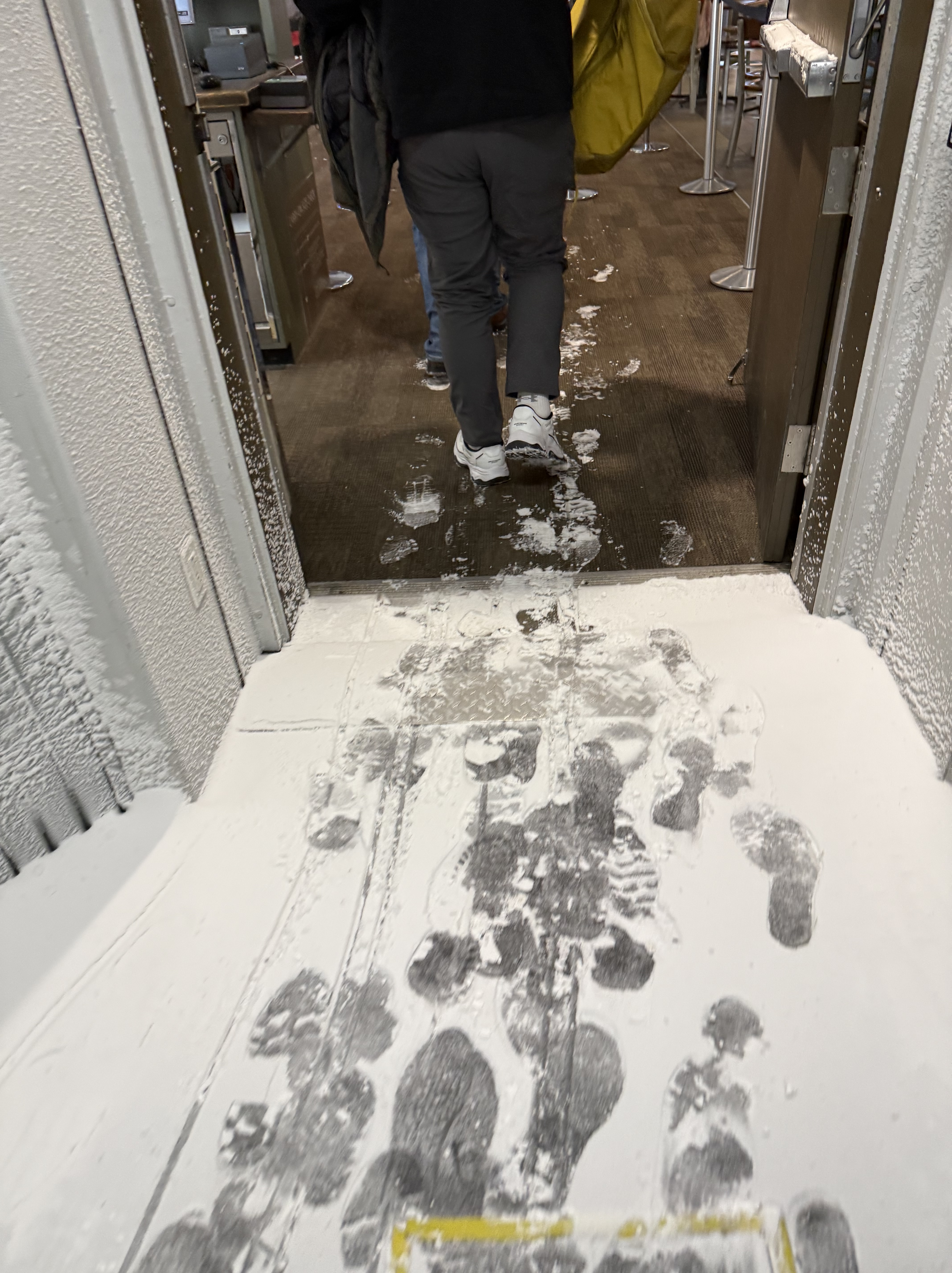
Apparently, it’s winter in Grand Forks, North Dakota. Who knew? Clearly not me. Being from balmy Montana where we’ve barely experienced any winter in 2025-2026, I arrived here in Grand Forks to the -25 F degree windchill without a stocking cap or gloves. What was I thinking, you ask? Well, maybe I was just in a here-and-now mindfulness state where the future had not yet arrived. Yep. That’s it. I didn’t forget to plan. I was just in the moment.
In this moment, I’m in my hotel room prepping for three things:
- My keynote presentation at Red River H.S.
- My hoped-for good night’s sleep, and
- How to get to the airport and make it to Boston before I get frostbite.
While prepping for these first two things I had an incredible epiphany and discovered or recovered the simple solution to insomnia. Some of this is old, so bear with me:
Sleep is a challenge for much of the U.S. population. If you struggle with sleep, join the club. It’s a big club. We welcome you, principally because misery loves miserable company.
There are three main forms of insomnia: (a) initial insomnia (aka difficulty falling asleep); (b) terminal insomnia (aka early morning awakening); and (c) intermittent insomnia (aka choppy sleep).
Several other factors also interfere with sleep including children, pets, light, your neighbors starting up their chainsaw, alcohol, caffeine, temperature, nightmares, and more.
This means that many Americans are awake in the night at times when they would rather be asleep. I know you’ve been there, done that, and will likely do it again.
But when you’re there in that “I wish I was sleeping” state, did you ever have the epiphany that you should stop trying to get back to sleep? Sure, you have. Maybe you’ve even gotten up. But that’s not what I’m about to suggest.
Because sleep is elusive and difficult to directly achieve, if you awaken in the night—and you have a pattern of insomnia—you could (and maybe should)—immediately let go of sleep as your primary goal. This is because if you have a goal and you’re not achieving it, you’re going to feel frustration and other unpleasant emotions (anger, sadness, anxiety, etc.) that are directly contrary to sleep.
Do you recall the main characteristic of a smart goal? A smart goal is within your control. If your goal is not within your control, then it’s a dumb goal. Make sense?
So, if you’re awake and struggling to return to sleep, try shifting your goal away from sleep and toward something that is, literally, the next best thing. You should shift to a goal of relaxation, of soothing, of comfort, of emotional peace, and of getting yourself into a generally pleasant state of mind and body. You can accomplish this via several strategies. You can meditate. You can count your breaths. You can use the Seligman technique of three good things. You can do progressive muscle relaxation. You can use the cognitive shuffle. Essentially, you can use anything you want that helps you get to an emotionally calm and pleasant state (although I recommend avoiding drugs and alcohol to get there).
Or, if you need more info on this stuff, plus sleep hygiene, you can watch the video linked below.
The point is that, over time and with practice, you will begin to be able to achieve your very pleasant, almost sleep state. And physically, physiologically, and emotionally, the benefits of almost sleep are very close to the benefits of sleep. But—on the other hand—if you directly keep pursuing sleep as your primary goal, you will feel frustrated and less restored that you would with almost sleep.
Experiencing frustration through the night offers you zero benefits.
I’ve thrown out several ideas here and this may not feel like the ultimate fix for your sleep issues, but then again, expecting to find an ultimate fix for your sleep problems will likely only magnify the problem. For most of us, there is no ultimate sleep fix. There is just time alone in bed with our own brain and our own thoughts, and so teaching ourselves to be as comfortable as possible with our brains and our thoughts is a fantastic goal.
If you want more on this, I’ve stolen the Module 3, Part 2 Sleep video from our Happiness for Educators course and the link is here (Note: for some reason, maybe because I pretended I was asleep at the beginning of this video, I seem—at least to me—to have a very slow pace in this video; of course, this may be a good thing; it could make you very, very, sleepy): https://www.youtube.com/watch?v=qOXW_5Df3UE
As for me, I’m looking forward to up to 850 Grand Fork educators tomorrow, so I’m stopping here, not in search of a good night’s sleep, but in search of experiencing a pleasant mental and emotional state, which just might translate to a more restorative nighttime experience. . . and maybe even more sleep.
 John Sommers-Flanagan
What a perfect snapshot to reflect what it’s truly like to arrive at GFK… Aaaahh my motherland!
Great article! I hope the cold helps you sleep well throughout your stay:)
Jennifer Switzer; a 2005 former UM student!
Thanks Jennifer! Not surprisingly, the people of Grand Forks were very nice. I had a video clip also. But today it’s just frigid, with no blowing snow.
Oh, they truly are wonderful people, aren’t they? Most operate on a whole different level of resilience up there…
Glad to hear you are enjoying your trip; I hope you make it back to Montana before the extreme cold hits later this week…!
On another note- We would love to have you over to Youth Homes again to hear updates on your Happiness research!
Safe travels!!
Jennifer