I’m continuing with the theme of featuring diverse identities from the Clinical Interviewing (7th edition) textbook with a case example written by Dr. Umit Arslan. Dr. Arslan is writing about his experience as an international graduate student in counseling, when he was at the University of Montana. Currently, he’s a faculty member at the University of Nebraska-Kearney.
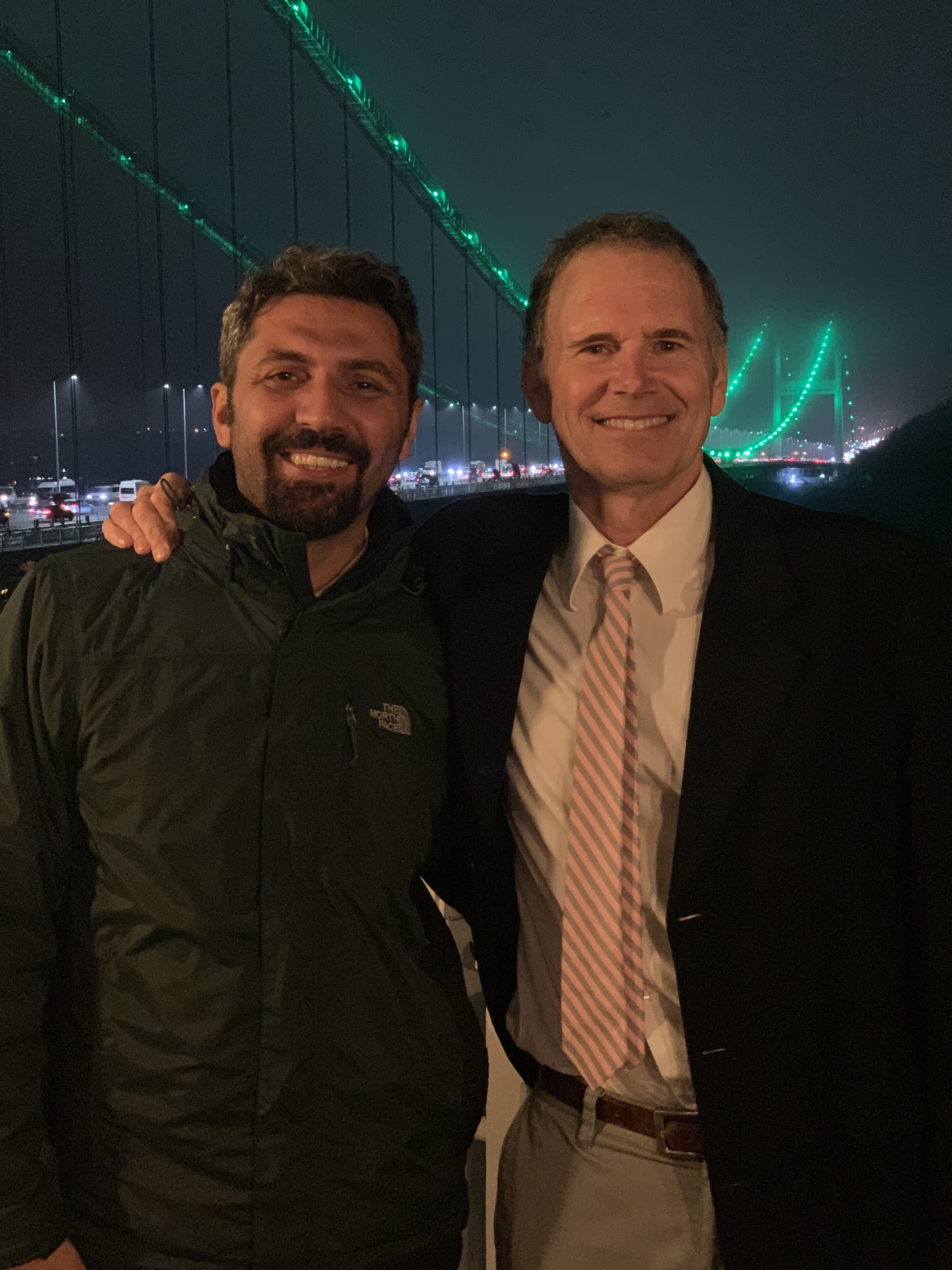
The photo is from when I visited him in Istanbul in January, 2023.
Enjoy!
As you’ll see below, Umit’s experience was unique. Given his Turkish heritage and cultural background, he needed to reflect and engage in a self-awareness process to experiment with finding a better way to introduce himself to clients. What I love most about this essay is Umit’s authentic description of his own experience. His answer to a better way to introduce himself won’t be the right answer for everyone. But his process is open and admirable.
CASE EXAMPLE 2.2: BEING A COUNSELOR FIRST . . . AND TURKISH SECOND, WORKED BETTER THAN BEING TURKISH FIRST . . . AND A COUNSELOR SECOND
Finding the right words and ways to introduce yourself is important. In this essay, Ümüt Arslan, Ph.D., an associate professor of counseling at İzmir Democracy University (Turkey), writes about challenges he faced as an international doctoral student in counseling at the University of Montana. Put yourself in Dr. Arslan’s shoes as he discovers (for him) a better way of introducing himself.
While pursuing my doctoral degree in the U.S., my supervisor and I discussed how to share my cultural identity and accent to clients. When I shared, my clients were not only interested in my appearance and accent, but also about my diet, coffee preferences, job, and of course, about my native country, Turkey. But they were reluctant to talk about themselves.
Clients assumed I was Muslim and against alcohol. Their assumptions were especially challenging because they were inaccurate. I was not religious, and like many Americans, I enjoyed having a beer after work. I wanted to challenge clients’ assumptions about my identity, but worried about countertransference and focusing too much on myself.
One cisgender female client came for an intake interview. She saw me, grabbed her bag (almost the size of a camping tent), and put it on her knees. I couldn’t see her face. I told her she could put the bag down if she wanted to. She declined.
When I re-watched this and other sessions, the striking thing was that my clients (mostly White) appeared stressed at the sight of me, a bearded Turkish man with dark skin. They didn’t even talk about the problems they had written on their intake form. My identity as a Turkish man overshadowed everything else. I needed a path forward.
In class, my supervisor discussed alternative ways to open sessions. I tried asking clients: “If you were the counselor today, what question would you ask yourself?” Clients suddenly engaged with me, giving deep and enthusiastic answers to their own questions. I stopped opening sessions by emphasizing cultural differences. Instead, I focused on my counselor identity, saying: “I completed my master’s degree and am currently a doctoral student. What do you think is the best question for me to ask you for us to have a good start here today?”The message, “I am here with my counselor identity” instead of “I’m a Turkish man in the U.S., and desperate to explain my culture to you,” had an amazing effect. Using a less cultural opening was more culturally sensitive. Clients could naturally introduce their own cultural identities, with fewer assumptions about me. Although I could still talk about culture, emphasizing my counselor identity enabled me to focus on counseling goals, the therapeutic relationship, and evidence-based counseling interventions.
[End of Case Example 2.2]
 John Sommers-Flanagan
What a thoughtful and talented man!
Once again, I am impressed by the thoughtfulness, quality, and curiosity shown here. Putting oneself in the patient’s/client’s shoes as a way of introducing oneself is terrific, and, even after years of teaching, is not something I’ve thought of in this way.
Thank you.
Thanks Jonathan! I agree with all you wrote. I hope all is well in your world. JSF