
During my supervision this week, I noticed that the concepts and process of Motivational Interviewing came up several times. When students or professionals don’t know the basics of Motivational Interviewing (MI), I feel compelled to speak up. MI is a method, strategy, or philosophy that’s complex, nuanced, and essential. We should all know about and have MI skills. To feel the centrality of MI to counseling and psychotherapy, it helps to start with MI’s most fundamental organizing principle.
“It is the client who should be voicing the arguments for change” (Miller & Rollnick, 2002, p. 22).
If you contemplate this principle (and you should), then you’ll need to examine your own role in the change process. That’s because, if look at (or listen to) yourself, and YOU’RE the one voicing the arguments for change, you must stop.
If you don’t stop, then you may be contributing to your clients’ resistance to change.
MI ideas are challenging to our natural impulses. We want to tell clients how to be healthier, but our job is not to voice the argument for positive and healthy change; our job is to nurture their argument for positive and healthy change. This is where the nuance comes in. How can we, as interviewers (aka counselors or psychotherapists) create an interaction wherein the client is more likely to take the lead in voicing the arguments for positive and healthy change?
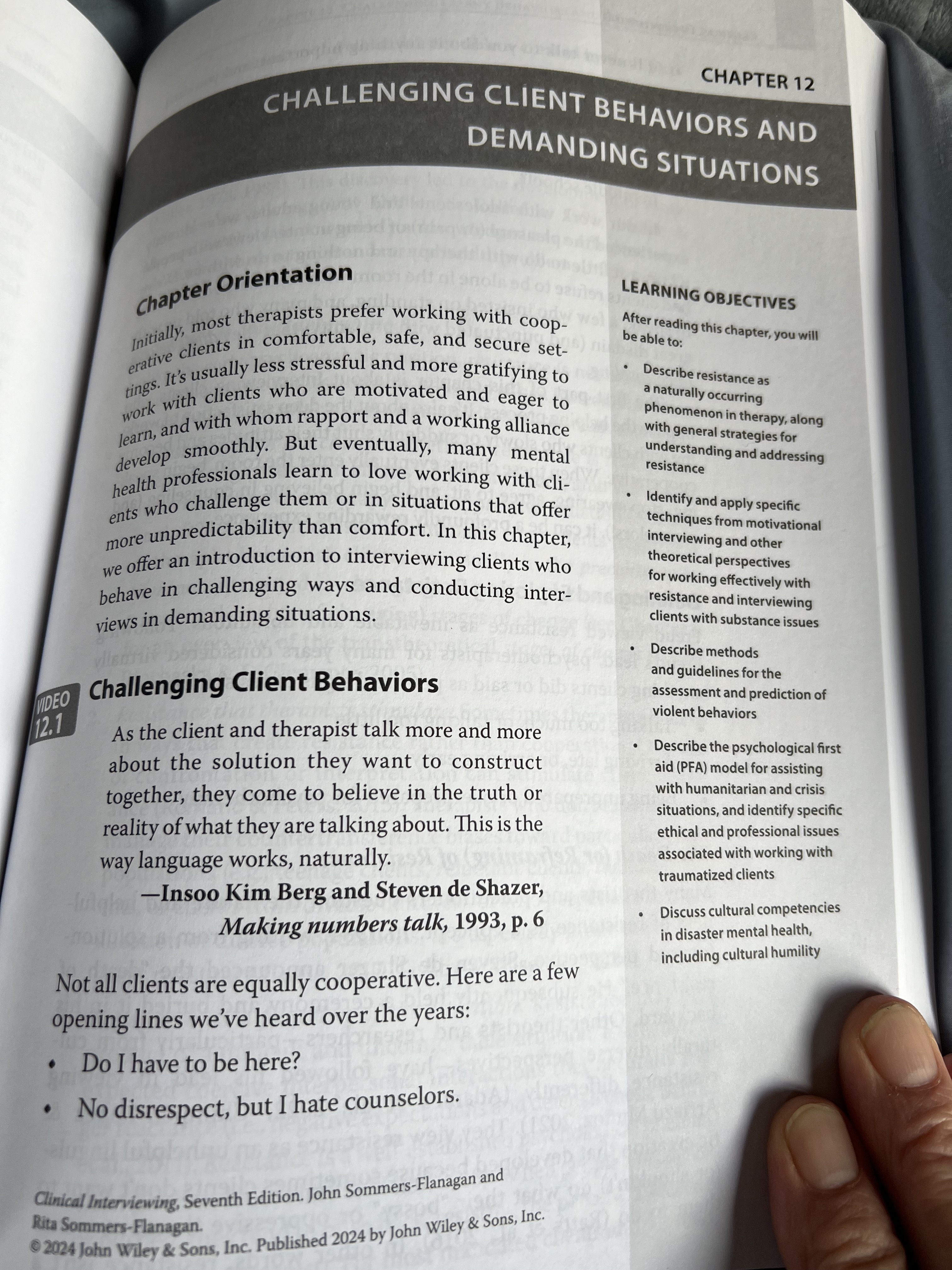
The answer to that question is complex, as it should be. In part, my answer today is to include an excerpt from Chapter 12 (Challenging Client Behaviors and Demanding Situations) of our Clinical Interviewing text. This excerpt starts with the topic of “Challenging Client Behaviors” or behaviors that clients engage in that counselors and psychotherapists often find challenging. The content includes a discussion of the concept of “resistance,” MI strategies, as well other ideas of our own and from the literature.
***************
Challenging Client Behaviors
As the client and therapist talk more and more about the solution they want to construct together, they come to believe in the truth or reality of what they are talking about. This is the way language works, naturally.
—Insoo Kim Berg and Steven de Shazer, Making numbers talk, 1993, p. 6
Not all clients are equally cooperative. Here are a few opening lines we’ve heard over the years:
- Do I have to be here?
- No disrespect, but I hate counselors.
- I’ll never talk to you about anything important, and you can’t make me.
- This is a shitty little office; you must be a shitty little therapist.
- How long will this take?
- How old are you? How are you supposed to help me if you’re still in middle school?
In our work with adolescents and young adults, we’ve directly experienced the pleasure (or pain) of being in interviews with people who want little to do with therapy, and nothing to do with us. We’ve had clients refuse to be alone in the room with us, others who refused to speak, a few who insisted on standing, and many who told us with great disdain (and punctuated with profanity) that they don’t believe in counseling.
The first part of this chapter is about interviewing clients who oppose the helping process. It’s also about the deep satisfaction of working with clients who slowly or suddenly shift their attitudes and become cooperative. When these clients eventually enter the room, begin speaking, stop swearing, agree to sit, and begin believing in counseling (and counselors!), it can be a profoundly rewarding experience.
Defining and Exploring Resistance
Freud viewed resistance as inevitable and ubiquitous. Following Freud’s lead, psychotherapists for many years considered virtually anything clients did or said as potential signs of resistance, such as
- Talking too much, or talking too little
- Arriving late, or arriving early
- Being unprepared or overprepared for psychotherapy
The Death (or Reframing) of Resistance
Many theorists and practitioners question the nature and helpfulness of resistance as a concept. In 1984, writing from a solution-focused perspective, Steven de Shazer announced the “death of resistance.” He subsequently held a ceremony and buried it in his backyard. Other theorists and researchers—particularly from culturally diverse perspectives—have followed his lead in viewing resistance differently (Adames et al., 2022; Chimpén-López, C., 2021). They view resistance as an unhelpful linguistic creation that developed because sometimes clients don’t want to (or shouldn’t) do what their “bossy” or oppressive therapist wants them to do (Ratts et al., 2016). In other words, resistance isn’t a problem centered in the client; it’s a problem created by therapists and the power dynamic this presents.
Around the time de Shazer was burying resistance in his backyard, William R. Miller was discovering that reflective listening, empathy, and encouragement with clients who had substance problems, outperformed confrontation and behavioral interventions (W. Miller, 1978, 1983). This discovery led to the development of motivational interviewing (W. Miller & Rollnick, 1991; Miller & Moyers, 2021). Motivational interviewing (MI) is now widely acknowledged as an effective treatment for health, substance, and mental health problems (McKay, 2021; Romano & Peters, 2015).
Resistance is Multidetermined
Unlike the early psychoanalytic position, resistance is neither inevitable or ubiquitous. But it’s probably not dead either. Instead, resistance (aka ambivalence or reluctance) originates from three main sources:
- Resistance from the client. Sometimes resistance is real, palpable, and originates from clients’ beliefs, attitudes, ambivalence, or internalized view of therapy as an oppressive situation (Adames et al., 2022). When resistance emanates from clients (regardless of therapist behavior), clients are usually in the precontemplation (not interested in changing) or contemplation (occasional transient thoughts of changing) stages of change (see Chapter 6 for an overview of the transtheoretical stages of change model; Prochaska & DiClemente, 2005).
- Resistance that therapists stimulate. Sometimes therapists behave in ways that create resistance rather than cooperation. Overuse of confrontation or interpretation can stimulate client resistance (Romano & Peters, 2015). Therapists who don’t examine and manage their countertransference biases toward particular client populations (e.g., teenage clients, reluctant clients, mandated clients, or clients from diverse cultures), or who perpetuate marginalization of diverse populations, are especially prone to creating client resistance (Ratts, 2017; Tishby & Wiseman, 2020).
- Resistance as a function of the situation. Resistance may be a product of a difficult and uncomfortable situation, a situation or expected coercive interpersonal interactions that naturally trigger reactance (i.e., negative expectations and defensiveness; Beutler et al., 2011). Reactance is a well-established psychological phenomenon (Brehm, 1966; Place & Meloy, 2018): When people feel coerced or pushed, they tend to push back, resisting the perceived source of coercion (e.g., therapist). For most mandated clients and for many ambivalent clients, resistance to therapy is a natural, situationally triggered behavior (J. Sommers-Flanagan et al., 2011). Also, for clients with diverse ethnicities or societally-marginalized identities, therapy can naturally feel like the repetition of power-imbalanced colonization experiences (Gone, 2021; Singh et al., 2020).
We realize that framing resistance as multidetermined and natural (or burying it) doesn’t automatically make it easier to handle (J. Sommers-Flanagan & Bequette, 2013). To therapists, resistance can still feel aggressive, provocative, oppositional, and threatening.
It’s unrealistic to expect all clients—especially adolescents or mandated adults in precontemplation or contemplation stages of change—to immediately speak openly and work productively with an unfamiliar authority figure. It’s also unrealistic to expect clients for whom therapy is a new and uncomfortable experience to immediately begin sharing their innermost thoughts. If you use the word resistance, it’s helpful to add the word “natural.” Doing so offers empathy for the client’s entry into an uncomfortable situation and acknowledges the need for strategies and techniques for dealing with client behaviors that are too easily labeled resistant (Hara et al., 2018; Miller & Moyers, 2021). The central question then becomes: What clinician behaviors reduce natural client resistance and defensiveness?
Motivational Interviewing and Other Strategies
In their groundbreaking text, Motivational Interviewing, W. Miller and Rollnick (1991, 2002, 2013) described a practical approach to recognizing and working with client resistance. They emphasized that most humans are ambivalent about personal change because of competing motivations. For example, a client may simultaneously have two competing motivations about smoking cigarettes:
- I should quit because smoking is expensive and unhealthy.
- I should keep smoking because it’s pleasurable and gives me a feeling of emotional control.
Imagine yourself in an interview situation. You recognize your client is engaging in a self-destructive behavior (e.g., smoking, cutting, punching walls). In response, you educate your client and make a case for giving up the self-destructive behavior. W. Miller and Rollnick (2002) described this classic scenario:
[The therapist] then proceeds to advise, teach, persuade, counsel or argue for this particular resolution to [the client’s] ambivalence. One does not need a doctorate in psychology to anticipate what [the client’s] response is likely to be in this situation. By virtue of ambivalence, [the client] is apt to argue the opposite, or at least point out problems and shortcomings of the proposed solution. It is natural for [the client] to do so, because [he or she] feels at least two ways about this or almost any prescribed solution. It is the very nature of ambivalence. (pp. 20–21)
In MI, resistance is framed as natural ambivalence about change. Consider this from a physical perspective. If you hold out an open hand and ask someone else to do the same and then push against their hand, the other person usually pushes back, matching your force. During a clinical interview, this process happens verbally. The more you push for healthy change, the more clients push back for staying less healthy (Apodaca et al., 2015).
This leads to the central MI hypothesis for resolving client ambivalence and activating motivation:
This points toward a fundamental dynamic in the resolution of ambivalence: It is the client who should be voicing the arguments for change. (W. Miller & Rollnick, 2002, p. 22, italics added)
But how can clinicians help clients make arguments for change?
MI practitioners refer to clients voicing their own arguments for change as change talk. When clients voice their arguments against change, it’s called sustain talk,because clients are arguing to continue or sustain their unhealthy behaviors. The central hypothesis of MI is that the more clients engage in change talk, positive change is more likely to occur.
MI has relational and technical components. The relational component involves embracing a spirit of collaboration, acceptance, and empathy. Embracing the relational component is crucial, if only because clients who report greater secure attachment to their therapists, also report less resistance (Yotsidi et al., 2019). The technical components include intentional evocation and reinforcement of client change talk (W. Miller & Rose, 2009). In practice, it’s difficult to separate the relational and technical components, and it’s likely more efficacious when they’re delivered together anyway. As you work with reluctant, ambivalent, or so-called resistant clients, you’ll need to make sure your Rogerian person-centered hat is firmly in place, while simultaneously using good behavioral skills to evoke and reinforce change talk.
Using Open Questions, Opening Questions, Evocation, and Goal-Setting Strategies
Open questions are fundamental to MI. However, W. Miller and Rollnick (2013) cautioned asking too many questions, including open questions:
A simple rhythm in MI is to ask an open question and then to reflect what the person says, perhaps two reflections per question, like a waltz. Even with open questions, though, avoid asking several in a row, or you may set up the question-answer trap. (p. 63)
Miller and Rollnick (2013) recommended loosely following their two-to-one waltz metaphor; the point is to do more reflecting than questioning. They offer a stronger warning against repeated closed questions, noting, “Chaining together a series of closed questions can be deadly for engagement” (p. 63).
When opening sessions with clients who may be unenthused to see you, you should use positive, strength-focused, empathic, and non-blaming opening questions:
- What brings you here today and how do you hope we might help? (Miller & Moyers, 2021, p. 95)
- What would make this a helpful visit?
- If we have a great meeting today, what will happen?
- What needs to happen in here for our time to be productive?
Open questions and opening questions are especially good tools for evoking clients’ strengths, hope, and solutions (McKay, 2021). Not surprisingly, reluctant clients tend to be more responsive when therapists pursue strengths, rather than pathology. Evocation is a technique used to help clients speak to their resources and strengths. Miller and Moyer (2021) view evocation as inherently containing the message: “You have what you need, and together we’re going to find it (p. 93”). If you’re using open questions to bypass natural resistance, you should aim toward evoking client change talk.
Consider the following example of using a variety of questions to facilitate change talk in an emergency room setting (M. Cheng, 2007, p. 163, parenthetical comments added):
Clinician: What would make today’s … visit helpful? (Clinician asks for goals.)
Patient: I want to kill myself, just let me die… (Patient states unhealthy goal/task.)
Clinician: I’m sure you must have your reasons for feeling that way … What makes you want to hurt yourself? (Clinician searches for underlying healthy goal.)
Patient: I just can’t stand the depression anymore and all the fighting at home. I just can’t take it. (The underlying healthy goals include coping with depression and fighting.)
Clinician: … so we need to find a way to help you cope with the depression and the fighting. You told me yourself that there used to be less fighting at home. What would it be like if we found a way to reduce the fighting, have people getting along more? (Clinician uses past hope to focus on future goal)
Patient: A lot better, I guess. But it’s probably not going to happen. (Client expresses little hope)
Clinician: Okay, I can see why you’re frustrated and I do understand that probably the depression makes it hard to see hope. But I believe that there is a part of you that is stronger and more hopeful, because otherwise you wouldn’t be here talking with me. (Clinician externalizes unhealthy thoughts or behaviors as being part of the depression and tries to help the patient rally against the depression.) That hopeful part of you said that your mood used to be happy. What would it be like if we could get your mood happy again?
Patient: A lot better I guess.
Clinician: Just to help me make sure I’m getting this right then, what would you like to see different with your mood? (The clinician reinforces the client’s goals by having the client articulate them.)
Patient: I want to be happy again.
Clinician: And at home, what would you like to see with how people get along?
Patient: I want us to get along better.
Clinician: Let’s agree then that we will work together on finding a way to help people get along, as well as help your mood get better. How does that sound? (Clinician paraphrases patient’s healthy goals.)
Patient: Sounds good… (Patient agrees with goals.)
In this example, Cheng (2007) illustrated how to help patients articulate goals and potential benefits of positive change (change talk). Although the process began with a negatively worded question—“What makes you want to hurt yourself?”—Cheng listened for positive, health-oriented goals. This is an important principle: Even when exploring emotional pain, you can listen for and resonate with unfulfilled positive goals contributing to that pain.
Using Reflection, Amplified Reflection, and Undershooting
Throughout this text, we’ve emphasized nondirective interviewing skills: paraphrasing, reflection of feeling, and summarizing. Research on MI supports this emphasis, showing that these reflective techniques are powerful tools for working with resistance (McKay, 2021). W. Miller and Rollnick (2002, pp. 100–101) provided examples of simple reflections that reduce resistance:
Client 1: I’m trying! If my probation officer would just get off my back, I could focus on getting my life in order.
Therapist 1: You’re working hard on the changes you need to make. Or,
Therapist 1: It’s frustrating to have a probation officer looking over your shoulder.
Client 2: Who are you to be giving me advice? What do you know about drugs? You’ve probably never even smoked a joint!
Therapist 2: It’s hard to imagine how I could possibly understand.
Client 3: I couldn’t keep the weight off even if I lost it.
Therapist 3: You can’t see any way that would work for you. Or,
Therapist 3: You’re rather discouraged about trying again.
When therapists accurately reflect client efforts, frustration, hostility, and discouragement, the need for clients to defend their positions is reduced.
Reflections also stimulate talk about the constructive side of ambivalence. While supervising graduate students in counseling and psychology as they conducted hundreds of brief interviews with client-volunteers, we noticed that when student therapists made an inaccurate reflection, the volunteer-clients felt compelled to clarify their feelings and beliefs in ways that rebalanced their ambivalence. For example:
Client: I’m pissed at my roommate. She won’t pick up her clothes or do the dishes or anything.
Therapist: You’d like to fire her as a roommate.
Client: No. Not that. There are lots of things I like about her, but her messiness really annoys me.
This exchange shows the interviewer inadvertently overstating the client’s negative view of the roommate. In response, the client immediately clarifies: “There are lots of things I like about her.”
As it turns out, the interviewer accidentally used an MI technique called amplified reflection (W. Miller & Rollnick, 2013). Amplified reflection involves intentionally overstating the client’s main message. W. Miller and Rollnick wrote: “As a general principle, if you overstate the intensity of an expressed emotion, the person will tend to deny and minimize it, backing off from the original statement” (p. 59).
When used intentionally, amplified reflection can feel manipulative. This is why amplified reflection is used along with genuine empathy and never includes sarcasm. Instead of being a manipulative response, it’s the therapist’s effort to deeply empathize with client frustration, anger, and discouragement. The following are amplified reflections. Scenario 1 involves a mother of a child with a disability and her ambivalence over whether she can take any time for self-care:
Client 1: My child has a serious disability, so I have to be home for him.
Therapist 1: You need to be home 24/7 and turn off any needs you might have to get out and take a break.
Client 1: Actually, that’s not totally true. Sometimes, I think I need to take some breaks so I can do a better job when I’m home.
Scenario 2 involves a college student with ambivalence over giving herself the time and space to grieve her grandmother’s death.
Client 2: When my grandmother died last semester, I had to miss classes and it was a total hassle.
Therapist 2: You don’t have much of an emotional response to your grandmother’s death—other than it’s really inconveniencing you.
Client 2: Well, it’s not like I don’t miss her, too.
Amplified reflection is an empathic effort to fully resonate with one side of the client’s ambivalence; it naturally nudges clients the opposite direction.
It’s also possible to use reflection to understate what clients are saying. W. Miller and Rollnick (2013) refer to this as undershooting. They advocate using it to encourage clients to continue exploring their thoughts and feelings:
Client: I can’t stand it when my mom criticizes my friends right in front of me.
Therapist: You find that a little annoying.
Client: It’s way more than annoying. It pisses me off.
Therapist: What exactly pisses you off about your mom criticizing your friends?
Client: It’s because she doesn’t trust me and my judgment.
In this example, the therapist uses an understatement and then an open question to continue exploring what hurts about the mother’s criticism.
Coming Alongside (Using Paradox)
Intentionally undershooting or using amplified reflections are subtle ways to move client talk in particular directions. A less subtle form of this is paradox. Paradox has traditionally involved prescribing the symptom (Frankl, 1967). For example, with a client who is using alcohol excessively, a traditional paradoxical intervention would involve something like, “Maybe you’re not drinking enough.”
Paradox is a high-risk and provocative intervention. We don’t advocate using traditional paradox. Interestingly, Viktor Frankl, who wrote about paradox in the early 1900s, viewed paradox as operating based on humor. It’s as if clients unconsciously or consciously understand the silliness of behaving in a destructive extreme and consequently pull back in the other direction. Frankl’s formulation might be viewed as working with ambivalence in a manner similar to MI.
W. Miller and Rollnick (2013) discuss using paradox to address resistance, but refer to it as coming alongside. Similar to amplified reflection, coming alongside is used with empathy and respect. The difference between amplified reflection and coming alongside is that in the latter the therapist makes a statement instead of a reflection. Here are two examples:
Client 1: I don’t think this is going to work for me, either. I feel pretty hopeless.
Therapist 1: It’s certainly possible that after giving it another try, you still won’t be any better off, so it might be better not to try at all. What’s your inclination?
Client 2: That’s about it, really. I probably drink too much sometimes, and I don’t like the hangovers, but I don’t think it’s that much of a concern, really.
Therapist 2: It may just be worth it to you to keep on drinking as you have, even though it causes some problems. It’s worth the cost.
Using coming alongside requires authentic empathy for the less healthy side of the ambivalence.
W. Miller and Rollnick (2002) commented on the difference between using coming alongside as compared to traditional paradox:
We confess some serious discomfort with the ways in which therapeutic paradox has sometimes been described. There is often the sense of paradox being a clever way of duping people into doing things for their own good. In some writings on paradox, one senses almost a glee in finding innovative ways to trick people without their realizing what is happening. Such cleverness lacks the respectful and collaborative tone that we understand to be fundamental to the dialectical process of motivational interviewing. (p. 107)
Paradoxical techniques should be delivered along with basic person-centered core attitudes of congruence, unconditional positive regard, and empathic understanding. Paradox shouldn’t be used as a clever means to outwit or trick clients, but to explore the alternative outcome out loud with the client and allow them to respond.
Using Emotional Validation, Radical Acceptance, Reframing, and Genuine Feedback
Clients sometimes begin interviews with hostility, anger, or resentment. If clinicians handle these provocations well, clients may open up and cooperate. The key is to keep an accepting attitude and restrain from lecturing, scolding, or retaliating if clients express hostility.
Empathy, emotional validation, acceptance, and concession can elicit cooperation. We often coach graduate students to use concession when power struggles emerge, especially when working with adolescent clients (J. Sommers-Flanagan & Sommers-Flanagan, 2007b). If a young client opens a session with “I’m not talking and you can’t make me,” conceding power and control can shift the dynamic: “You’re absolutely right. I can’t make you talk, and I definitely can’t make you talk about anything you don’t want to talk about.” This statement validates the client’s perspective and concedes an initial victory in what the client might view as a struggle for power. MI therapists refer to this as affirming the client.
Empathic, emotionally validating statements are also important. If clients express anger about you or therapy, a reflection of feeling and/or feeling validation response communicates that you hear their emotional message. In some cases, you can go beyond empathy and emotional validation and join clients with parallel emotional responses:
- I don’t blame you for feeling pissed about having to see me.
- I hear you saying you don’t trust me, which is totally normal. You don’t know me, and you shouldn’t trust me until you do.
- It sucks to have a judge require you to meet with me.
- I know we’re being forced to meet, but we’re not being forced to have a bad time together.
Radical acceptance (RA) is a principle and technique based on person-centered theory and dialectical behavior therapy (Görg et al., 2019). RA involves consciously accepting and actively welcoming all client comments—even odd, disturbing, or blatantly provocative comments (J. Sommers-Flanagan & Sommers-Flanagan, 2007a). Here’s a case where a client began a session with angry statements about counseling:
Opening client volley: I don’t need no stupid-ass counseling. I’m only here because my wife is forcing me. This counseling shit is worthless. It’s for pansy-ass wimps like you who need to sit around and talk rather than doing any real work.
RA return: Wow. Thanks for being so honest about what you’re thinking. Lots of people really hate counseling but just sit here and pretend to cooperate. I really appreciate your telling me exactly where you’re coming from.
RA can be combined with reframing to communicate a deeper understanding about why clients have come for therapy. One version of this is the love reframe (J. Sommers-Flanagan & Barr, 2005).
Client: This is total bullshit. I don’t need counseling. The judge required this. Otherwise, I can’t see my daughter for unsupervised visitation. Let’s just get this over with.
Therapist: You must really love your daughter to come to a meeting you think is bullshit.
Client: (softening) Yeah. I do love my daughter.
The magic of the love reframe is that clients nearly always agree with the positive observation about loving someone. The love reframe shifts the interview to a more pleasant and cooperative focus.
Often, when working with angry or hostile clients, there’s no better approach than reflecting and validating feelings … pausing … and then following with honest feedback and a solution-focused question.
I hear you saying you hate the idea of talking with me. I don’t blame you for that. I’d hate to be forced to talk to a stranger about my personal life too. But can I be honest with you for a minute? [Client nods in assent.] You’re in legal trouble. I want to be helpful—even just a little. We’re stuck meeting together. We can either sit and stare at each other and have a miserable hour, or we can talk about how you might dig yourself out of this legal hole. I can go either way. What do you think … if we have a good meeting today, what would we accomplish?
*********************
The chapter goes on and on from here, including content on dealing with clients who may be delusional, as well as substance abuse interviewing.
Also, if you want more info, here’s a nice article, albeit dated, where Miller and Rollnick write about 10 things that MI is NOT.

 John Sommers-Flanagan