

Hardly anyone with common sense or social skills ever argues about whether or not relationship factors are crucial to effective counseling and psychotherapy. Nevertheless, some scientists are reluctant to put relationship factors on par with counseling and psychotherapy techniques or procedures. IMHO, relationship factors are every bit as essential as so-called empirically-supported treatments.
This post is a pitch. Or it might be a pitch in a post. Either way, I am honored to share with you a hot-off-the-presses new book, titled Relationship Factors in Counseling, by Dr. Kimberly Parrow. Here’s the publisher’s link: https://titles.cognella.com/relationship-factors-in-counseling-9781793578754. The book is also available on Amazon and other booksellers.
Below, I’m pasting the Foreword to this book. Not only am I jazzed about the book, I’m also jazzed about the Foreword. You should read it. It’s really good. You’ll learn about Kimberly Parrow, as well as a bit of trivia about relationship factors that you should definitely know. I haven’t mentioned who wrote the Foreword, but I’m sure you’ll figure it out.
I first met Kimberly Parrow, before she was Dr. Kimberly Parrow, in a letter of recommendation from a psychology professor at the University of Montana. Having read well over 1,000 letters of recommendation over the years, this one imprinted in my brain. The professor wrote something like, “Kimberly Parrow is the real deal. You should admit her to master’s program in clinical mental health counseling. You will never regret it.”
We did (admit her into our master’s program . . . and our doctoral program). And we didn’t (ever regret it).
Kim Parrow was, is, and continues to be one of the most enthusiastic learners I’ve encountered. She walked onto our campus at 44-years-old, as a first-generation college student, having waited with bated breath for the money and opportunity to pursue her college degree. Nine years later she strolled off campus with her bachelor’s, master’s, and doctoral degrees. If we were Notre Dame, we’d call her a triple domer (n.b., that’s what you call people with three degrees from Notre Dame). At the University of Montana, we just call her amazing.
In one of her first doctoral classes, I introduced Kim to the concept of evidence-based relationship factors (EBRFs). She was hooked; hooked in the way that only graduate students get hooked. She was hooked by an idea. So hooked that she immediately wanted more; she wanted to write a journal article on EBRFs (so we did). She wanted to do her dissertation on EBRFs (so she did). She wanted to do extra additional trainings for practicum and internship students on EBRFs (and so she did). Kim’s attraction to EBRFs stemmed from her belief that relationships constitute the core of what’s therapeutic. As we explored EBRFs together, noting all the research supporting the idea that relationships drive counseling and psychotherapy, I came to see that Kim’s judgment was, and continues to be, practically perfect.
I’ve been reading dissertations for 30+ years. I’m embarrassed to say that I find reading most dissertations—even those written by students whom I love—drudgery. But Kim’s dissertation was electric. Page by page, she kept surprising me with new content and new learning; it was more than I expected. Kim had taken the basic knowledge and skills linked to EBRFs, contextualized them within the scientific literature, and then wrote about them in ways that inspired me to keep reading and keep learning. As she wrote more, her writing got better and better, and the content more illuminating.
About a month ago, I was unable to make it to my initial lecture for an advanced counseling theories course. I asked Kim to fill in. She quickly said yes. I offered to pay her. She quickly said no. To stick with the money theme, if I now had a dollar for every time one of my students has, since Kim’s lecture, mentioned Kim Parrow, eyes agog, and referenced the central role of relationship factors in counseling and psychotherapy, I would have many dollars. What I’m trying to say is that Kim is a natural and talented clinician-teacher. That’s a rare version of the real deal her former developmental psychology professor was trying to tell us about.
And now, a few words about this book. Kim has done what most scholars and professionals are unable to do. She has taken theoretical principles, empirical research findings, blended them with her common-sense-salt-of-the-earth style, and created a practical guide for helping counselors and psychotherapists be better. The book is aimed to slide into the educational development of practicum and/or internship students who have learned microskills and are facing their first clients. This particular point in student development is crucial; it’s a time when students sometimes lose their way as they try to make the improbable leap from microskills to counseling and psychotherapy techniques. In making that leap, they often fall prey to the urge to quickly “prove up” and “do something” with clients. In this process, they often abandon their microskills and forget about the therapeutic relationship. Kim’s overall point is this: Don’t forget about the therapeutic relationship because relationship factors are every bit as evidence-based as theory-based or research-based technical strategies. The renowned writer-researcher John C. Norcross put it this way:
Anyone who dispassionately looks at effect sizes can now say that the therapeutic relationship is as powerful, if not more powerful, than the particular treatment method a therapist is using.
The fact that therapeutic relationships are empirically supported makes Kim’s content relevant not only to students early in their clinical development, but also to all of us. Having taught this content with Kim, and to groups of professional counselors, psychologists, and social workers across the United States, I can say without hesitation that the content in this book can and will make all of us better therapists.
Kim covers 10 specific, evidence-based interactive relationship skills. What unique—and possibly the best thing about Kim’s coverage of relationship skills—is that she provides specific, actionable guidance for how to enact these 10 skills. As a preview, the 10 skills include:
- Cultural humility
- Congruence
- Unconditional Positive Regard
- Empathic Understanding
- The Emotional Bond
- Mutual Goal-Setting
- Collaborative Therapeutic Tasks
- Rupture and Repair
- Countertransference Management
- Progress Monitoring
In the pages that follow, you will get a taste of Kim Parrow’s relational orientation and a glimpse of the evidence supporting these 10 relationship factors as therapeutic forces that innervate counseling process. You will also experience the magic of a talented clinician-teacher. The magic—or, if you prefer, secret sauce—is Kim’s ability to make these distant intellectual relationship concepts real, practical, and actionable. To help make relationship concepts real, she has engaged several contributers (and herself) to write pedagogical break-out boxes titled, “Developing Your Skills.” Engaging with these skill development activities will, as the neuroscience fans like to say, “Change your brain” and help you develop neural pathways to enhance your relational connections.
As I write about skills and skill development, I’m aware that Carl (and Natalie) Rogers would view the reduction of his core conditions to “skills” as blasphemy. This awareness makes me want to emphasize that Kim “gets” Rogerian core conditions and does not reduce them into simple skills. Instead, she embraces the attitudinal and intentional dimensions of Rogerian core conditions, while simultaneously offering behaviors and words that counselors and psychotherapists can try on in hopes of expressing congruence, unconditional positive regard, and empathy.
I’ve had a few conversations with Derald Wing Sue over the years and he has always emphasized that culture in counseling and psychotherapy shouldn’t be relegated to a separate chapter at the end of the book—as if culture is ever a separate or standalone issue. Reading how Kim handles culture reminded me of Derald Wing Sue’s message. Instead of relegating it to the end, Kim begins with the relationship factor of cultural humility. That makes for a beautiful start. Cultural humility involves, above all else, the adoption of a non-superiority interpersonal stance. . . which is a simple and excellent anti-racist message. But Kim doesn’t stop talking about culture after Chapter 1. She does what Derald Wing Sue recommends: She integrates cultural awareness, knowledge, and skill development into the whole book. This stance—non-superiority and anti-racist—is consistent with Kim’s interpersonal style and is also the right place to start as counselors set about the journey to collaborate and co-create positive outcomes.
One of Kim’s writing goals is to offer ideas and activities that are likely to increase counselor cognitive complexity. You can see that in the two preceding paragraphs. Instead of reducing Rogerian core conditions into skills, she honors how they can become both attitudes and skills. And instead of putting culture into a silo, she spreads seeds of culture through all her chapters.
This book is a remarkable accomplishment. The language, the examples, the science, the skill development activities, and the tone, welcome readers to engage with this book, and bring the material to life. I believe if you read this book and engage in the activities, your counselor self-efficacy will grow.
For anyone who has gotten this far in reading this foreword, I have some reading tips to share. First, read this book with your heart wide open. I say this because this book is about the heart of the counselor or psychotherapist. Second, as you read, keep yourself in relationship with Kim. The book is about relational factors and the details Kim shares will not only help you in your relationships with clients, but, as she often reminded me and other people whom she cornered so she could talk to us about relational factors, these relationship factors are relevant and applicable to all relationships.
Obviously, I respect Dr. Kimberly Parrow and believe she has produced an excellent book. Obviously, I think you should read this book and do as so many of us have already done, learn about evidence-based relationship factors from someone who is a remarkably talented clinician-teacher. To paraphrase what that developmental psychology professor wrote about Kim many years ago, you should accept Kim Parrow into your personal program of learning immediately, and begin learning from her as soon as you can. You will not regret it.
All my best to you in your counseling and psychotherapy work.
John Sommers-Flanagan
Missoula, Montana

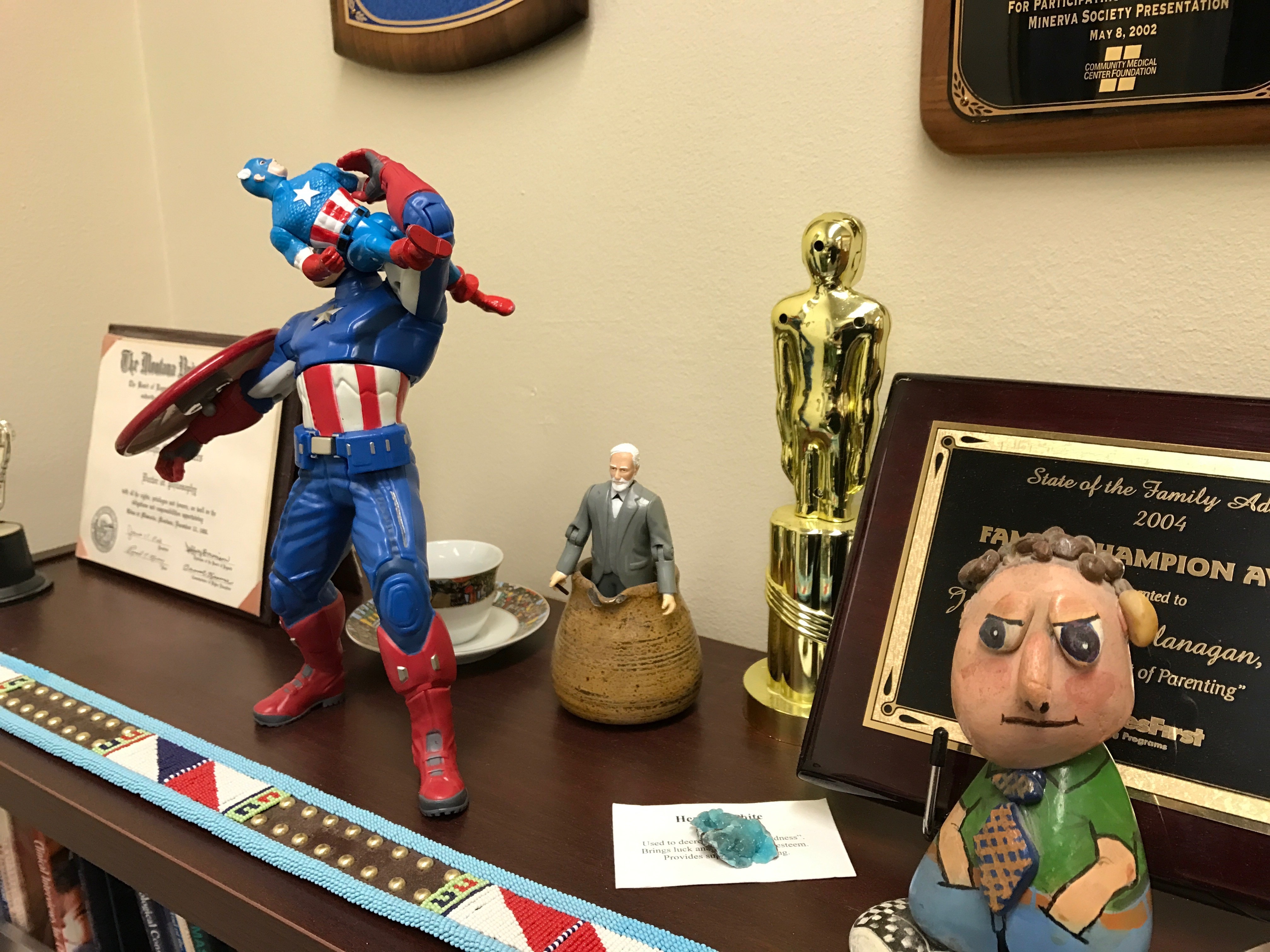

 John Sommers-Flanagan