
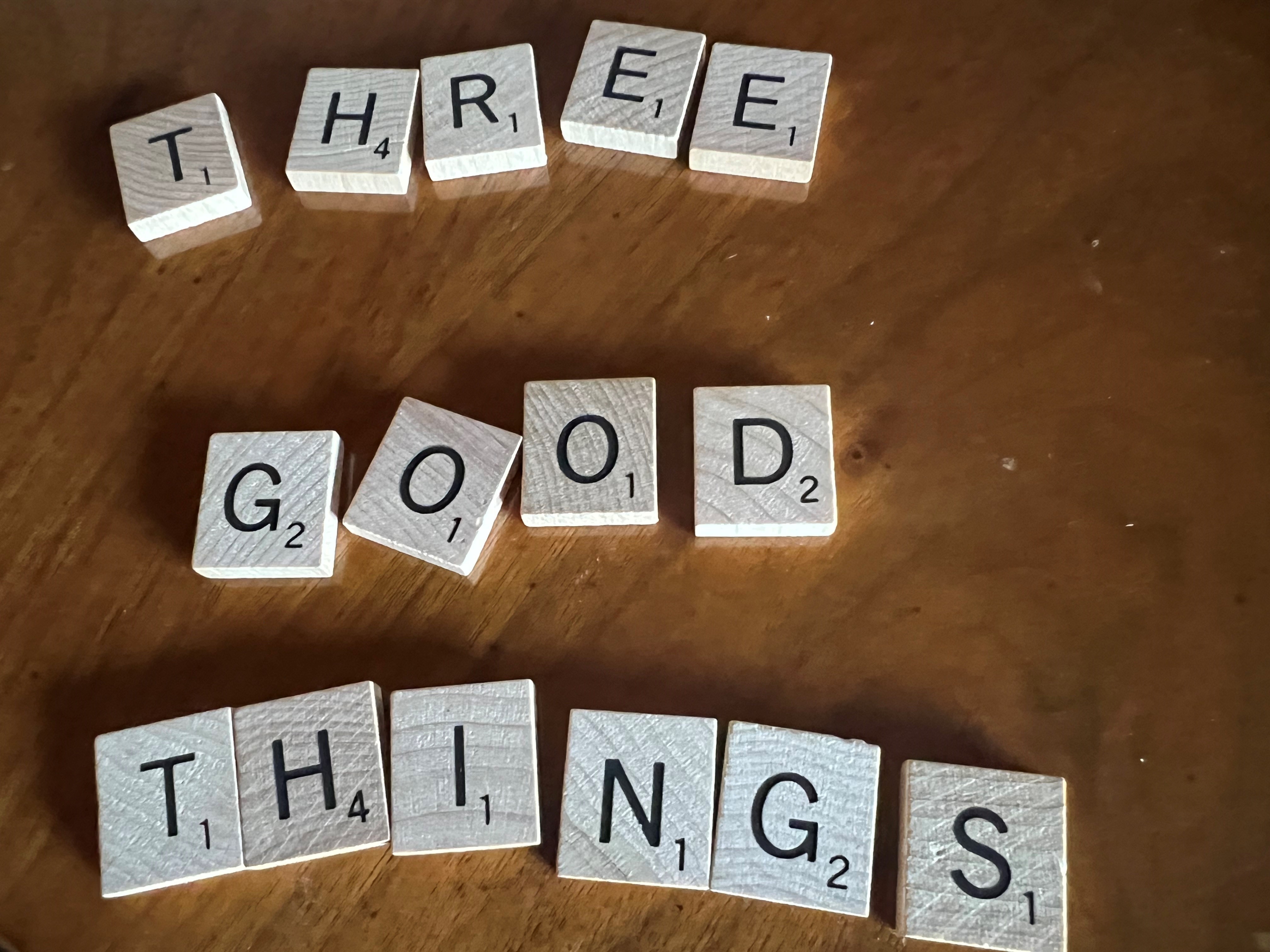
This week, for the Montana Happiness Challenge, we’re encouraging participants to experiment with Martin Seligman’s “Three Good Things” technique. Three good things (TGT) is an evidence-based positive psychology intervention. For example, six months of twice-weekly TGT has been shown to decrease burnout in nurses (Luo et al., 2019) and four weeks of unguided internet-based TGT reduced insomnia in adults (Sato et al., 2022). In Seligman’s (Seligman et al., 2005) original research, TGT had positive effects on mood and depression.
Like everything, TGT is not one-size fits all. You should use it in any way that works for you. You can start with Seligman’s instructions, and riff on it from there. For me, I like it best at 4am, when I wake up and my brain seems preoccupied with depressing things. If you want to listen to me talking about TGT, here’s a 5+ minute video: https://www.youtube.com/watch?v=45fsZMDMPOQ
If you want to read the long and winding version of this happiness activity, I’ve pasted it below the references. If not, just jump right in, try it out, and post your thoughts and reactions on your favorite social media platform.
References
Luo, Y., Li, H., Plummer, V., Cross, W. M., Lam, L., Guo, Y., . . . Zhang, J. (2019). An evaluation of a positive psychological intervention to reduce burnout among nurses. Archives of Psychiatric Nursing, 33(6), 186-191. doi:https://doi.org/10.1016/j.apnu.2019.08.004
Sato, D., Sekizawa, Y., Sutoh, C., Hirano, Y., Okawa, S., Hirose, M., . . . Shimizu, E. (2022). Effectiveness of unguided internet-based cognitive behavioral therapy and the three good things exercise for insomnia: 3-arm randomized controlled trial. Journal of Medical Internet Research, 24(2), 1-17. doi:https://doi.org/10.2196/28747
Seligman, M. E. P., Steen, T. A., Park, N., & Peterson, C. (2005). Positive psychology progress: Empirical validation of interventions. American Psychologist, 60(5), 410-421. doi:https://doi.org/10.1037/0003-066X.60.5.410
 John Sommers-Flanagan