
Today is the official launch of the Montana Happiness Challenge. For the next 20 weeks we’ll be trying to spread happiness from social media into classrooms, kitchens, boardrooms, ballrooms, and everywhere else you’ll help us spread it.
The concept is simple.
- Happiness takes work and involves behavior. We’re not JUST talking about “smiley” hedonic happiness; we’re also talking about eudaimonic, meaning-filled happiness.
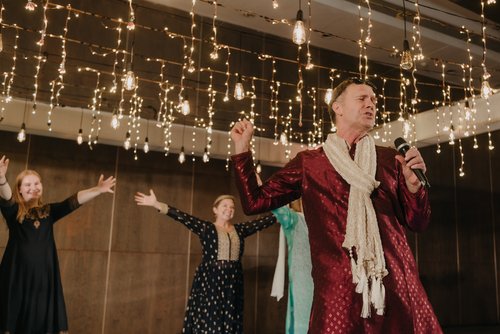
- Today’s activity involves music. You can interpret this and share this in nearly any way you like. You can just post your #Happysong somewhere, or share it with a friend, family, coworker, or classroom. You can also sing. . . and post it on Youtube or Facebook or Insta or wherever you like. You can include our cumbersome hashtags #MHPHappinessChallenge and #MontanaHappiness and Tag us, or just stay quiet. But, if you like, don’t shy away from posting photos of yourself singing, even if they’re slightly embarrassing, like this one.
Below is the full description of the first Happiness Activity. Please engage and experience and experiment as you wish. . . all week long!
Happiness Activity 1 – Music, Mood, and Meaning
John Sommers-Flanagan, Ph.D.
University of Montana
Music in general, and songs in particular, trigger happiness, sadness, other emotions, and life memories. Sometimes our emotional responses to music are all about the music. Other times our emotional responses are about personal emotions and memories that the songs trigger. For example, when I listen to “Joy to the World” by Three Dog Night, I’m transported back to positive memories I had playing 9th grade basketball. The song, “Put the Lime in the Coconut” by Harry Nilsson will forever take me back to a car accident with my sister in 1973. It’s not unusual for us to turn to music for help regulating our emotions, or to deepen particular feelings. The connection between music and mood is so powerful that psychological researchers frequently use music when they want to manipulate the mood of their research participants.
For this assignment, do the following:
Part One: Your Happy Song(s)
- Select a song or songs that trigger positive emotions. We’ll call that your #HappySong.
- Listen to your happy song once or twice, or whatever it takes to let the song do its work. You can do this with your family or a friend or by yourself. Consider how you might use that song to intentionally elevate your mood.
- At minimum, share your #HappySong on social media or with your friends/family. You can just share the name and artist, provide a link to the song.
- Because creating music and singing can be especially powerful, consider making a clip of yourself performing your #HappySong.
- If you want to get deeper, you can share on your favorite social media platform why that’s a happy song for you or how you use it as a “go-to” happy song when you need an emotional lift, or you can share your personal memories around the song.
Part Two: Your Meaningful Songs
Sometimes music gives us an emotional boost. Other times, it helps us go deeper into challenging emotions or allows us to find meaning in hard times. When I was struggling in graduate school, I would often listen to Paul Simon’s “American Tune” or “Immigrant Song.” I very much resonated with these (and other) lyrics “I don’t know a dream that’s not been shattered, or driven to its knees.” Often the tears would flow. [I love this version, with Simon and Rhiannon Giddens: https://www.youtube.com/watch?v=67pyIglP79U]
For the meaning part of this activity, consider the following:
- Share a song that holds meaning for you. This might be a song you listen to when feeling sad or angry or scared. While I was teaching a Happiness Class at the University of Montana, a student shared a beautiful song by Mandoline Orange (now Watchhouse) titled, “Golden Embers” Golden Embers is about the death of the singer’s mother. My mother died not long after I heard this song, and even though the lyrics don’t perfectly fit my experience or my mother, when I listen I think of her and let myself feel the grief I have around the loss of her presence in my life and in the world. You can listen to Golden Embers here: https://www.youtube.com/watch?v=fEt2lf7L13g
- As with the Happy Songs above, you can just share the song with your friends/family/colleagues or share it on your favorite social media platform. You can also go into details about why the song is emotionally meaningful for you. Do this is whatever way you find meaningful and share what you’re comfortable sharing.
- Obviously, this is a much more vulnerable activity than the Happy Song version . . . and so participate only to the extent that feels okay for you. Also, if you notice others posting their emotionally meaningful songs, please find ways to offer support and respect for their insights and vulnerability.
Thanks for reflecting on how music affects our emotions, life meaning, and quality of life. I hope you’ll stay tuned for our next Happiness Activity coming out Sunday, October 8.
P.S.: for those of you who want to read more about music, mood, and meaning, here’s a recent Washington Post article, compliments of Lillian Martz from the University of Montana:
 John Sommers-Flanagan