Over the past several days I’ve been inspired to pursue a new project that focuses on writing about professional writing. This is the sort of thing that happens to me when I’m facing a big list of imposing writing projects . . . I decide to add one more.
But the good news is that I’m having fun and producing lots of words on this topic. My latest method for generating words is to go for a long walk with my cell phone. Then, I dictate email messages to myself through my cell phone and send them. Pretty cool. Over the past two days I’ve “written” almost 8,000 words.
There are some problems with this system, however. In particular, if there’s any wind, or if I don’t enunciate perfectly, my phone is inclined to misquote me. The result: In the moment I feel exceptionally articulate and then I when I get home and read the emails I’ve sent myself, I sound somewhat less articulate. Here’s an example:
1 thing keep in mind is: your trickster is not my sister. What is means is that are in your obstacles 4 demons are unique to us as individuals. You wear the standard prescription for all riders. Beware the single strategy you overcome writers block. He wear even if we say it, love 1 message to manage your picture.
You can imagine my disappointment at receiving this message from myself, I’m sure. If that preceding paragraph wasn’t absolutely hilarious, I might be furious at having lost whatever profound message I was trying to communicate with myself. But I have to say that reading these emails from myself makes for excellent entertainment.
This reminds me of a dream I had back in grad school. It was amazingly profound . . . but I’ll skip that and get to the point of asking you for feedback.
If you’re a current or recent graduate student, please send me your answer to one or more of the following questions:
1. What emotions and thoughts do you experience when you turn in a paper to a professor (or, better yet, a thesis or dissertation committee)?
2. When you get lots of “constructive feedback” what thoughts and feelings do you experience? This might involve you receiving a paper back with a low grade and/or lots of “red ink.” Can you share an example of what you think or feel in response to that situation?
3. When you get positive feedback, what thoughts or feelings does that trigger? Can you share an example?
4. After you’ve gotten negative or constructive feedback, how do you find the strength or courage to send in another draft or turn in the next assignment?
If you’re currently a professor somewhere, consider answering one or more of the following:
1. What thoughts or feelings do you have to deal with to get yourself to write something?
2. How do you react to or deal with rejection? For example, if you have a manuscript or proposal rejected, what do you say, do, think, or feel? What do you do to “bounce back” from rejections of your written work?
3. How do you react to success? For example, when you have a paper accepted or get positive feedback, how does that affect you?
4. What helps you write well . . . or in what situations are you likely to write efficiently.
Thanks for thinking about this with me. I appreciate it. And I’ll even appreciate it more if you send me an email answering some of the preceding questions. Send it to: john.sf@mso.umt.edu
And . . . I’m confident that whatever you send me will arrive in better shape than the emails I’ve been sending myself.
This is the transcript of the 2015 Graduation Speech for Counselor Education I didn’t give. Of course, I wasn’t invited to deliver a speech, but since I’m in Absarokee and can’t attend graduation, I’m pretending this is the speech I would have given. In other words, I’m making all this up.
The Speech
Traditional graduation speeches are supposed to be lightly profound with a dose of inspiration. This one, not so much.
Seriously? Like you didn’t know this speech would be different?
Two years ago (or maybe three or four years ago for some of you who are extra special), you all enrolled in a graduate program in . . . COUNSELING. What I’m saying is that something in your rational brain snapped and you let an empathic, compassionate, impulse to help others for the rest of your life take over and start making your BIG life decisions for you. You know you did. And your family and friends know you did. I’m just naming the elephant in the room by saying it in public
I’m proud to say that I’m proud of you for that. And this is coming from someone who basically hates and avoids the word proud. That’s partly because pride is one of the seven deadly sins and it goeth before a fall and all that. I just thought you should know how hard it was for me to say that I’m proud of you . . . which makes me think in my head that I almost feel a little proud of myself, which I would never, of course, say out loud, which I’m not doing now because if there’s anything I’m certain of, I’m certain you can’t hear my thoughts.
What I am saying is that I’m glad you made the decision to forsake nearly all of the materialistic messages given to you, heretofore (I really like saying things like heretofore, especially during graduation speeches), by contemporary society. Just think, if everyone went down the evil road of materialism we wouldn’t even have graduate programs in counseling where people like you spend good money to learn how to listen well and help others, while not making very much bank. You know what I’m talking about.
My point is, you’re just DIFFERENT and unless your faculty forgot to tell you, you should know that by now. And my other point is: that’s why you should have known this would be YET ANOTHER LECTURE and not some sappy, emotionally inspiring speech. And the reason for this is that in the business you’ve chosen to practice . . . learning NEVER ENDS . . . and so I don’t want to give any of you the wrong impression that somehow graduating means you get to stop learning. You don’t. I’m here to tell you that.
This leads me to my lecture, the title of which is something like:
Everything I Should Have Taught You Over the Past Several Years,
But Because You All Talked Way Too Much In Class I Didn’t Have Time.
And I should mention that this lecture could take anywhere from a few minutes to several days. Please. There’s no need to thank me. You’ve earned this.
Let’s start with you taking notice of the imprecision I used in stating my lecture title. I said, “. . . something like.” This is our first and most important lesson for the day. When it comes to counseling humans, we shouldn’t fool ourselves into thinking we can be precise. This is why you chose to study with us touchy-feely-counseling types over here in the College of Education instead of running over with your calculators to psychology where you could be a scientist (at this point in the speech I’m making an enigmatic face that makes you wonder if I’m praising psychology as a science or making fun of psychology for having lots of irrational cognitions about being a science). This is why you set collaborative goals in counseling and not unilateral goals.
As Salvadore Minuchin said a couple of decades ago at a workshop here in Missoula, “Don’t be too sure.” I like that message.
And now although I’m not too sure about whether what I’ve got planned next is a good idea, it’s something I feel compelled to teach you. After all, prior to this last year’s holiday party, when there was an opportunity for Karaoke and, in the humble way that you’ve come to know as characteristic of me, I sent you all an email explaining that I had co-invented Karaoke in 1973 in Mike Bevill’s basement and consequently was happy to provide everyone with Karaoke lessons, the response was COMPLETE EMAIL SILENCE. Consequently, how could I not conclude that either you (a) have debilitating Karaoke anxiety, or (b) have low Karaoke-esteem, or (c) are uninformed as to the benefits of Karaoke, or (d) all of the above, or (e) only a and b?
Hopefully you got the answer to that rhetorical question correct, because here comes the Karaoke lesson.
OLYMPUS DIGITAL CAMERA
Before I start, as I like to say in my classes and workshops, you can always pass on this experience and if you so choose, please do so by doing what many of my teenage clients do – ignoring me – which may or may not involve you placing your hands over your ears and humming or laying your head on your arm and snoring.
The first rule of Karaoke is, as the late Bill Glasser would have said—had he ever had the good sense to lecture on Karaoke—“Your goal should be within your personal control.”
This rule has several implications, but most importantly, it speaks to song and wardrobe selection. Specifically, you always want to select a Karaoke song that’s within your range and within your wardrobe. I cannot emphasize this enough. For example, although I very much like the song . . . “This Girl is on Fire,” but I tried singing it and it didn’t go well.
As you can infer from the photo below, choosing the wrong song can be embarrassing and beyond your control. Don’t do it . . . unless it’s part of your shame- attacking treatment plan. And you can thank Dr. Albert Ellis for building you a personalized shame-attacking treatment plan.
So, obviously, pick a song that fits your voice and your gender stereotypes.
The second rule is all about song lyrics and so I’ve made up another rhyme to help you auditory learners remember. That is, “To function to the best of your ability, you should embrace your multicultural humility.”
What I’m saying here is that, as you know, many pop songs have lyrics that are racist, sexist, and sexually explicit. To maintain our multicultural sensitivity (and humility), it’s important to either (a) avoid songs with insensitive or sexualized lyrics (which is why I never sing Lady Gaga’s song that includes the line about her not bluffin’ with her muffin) or (b) change the lyrics on the spot (for “Say a Little Prayer for You” I like to substitute, “Do a little non-denominational mindfulness meditation for you.” It works fine, you just have to say the words very quickly) or (c) just mumble when the offending lyrics appear.
The third rule can also be captured with a nifty, easily memorized rhyme: “An alcoholic drink, will not help you think.” It also won’t improve your judgment or make you look more impressive to your audience. I hope what I’m saying here is clear. Just like when you’re providing professional counseling, when doing Karaoke, it’s best to be squeaky clean and sober. I should also add, contrary to popular belief, drinking alcohol will NOT MAKE YOU A BETTER DANCER. Although the caveat to this is that if OTHERS are drinking alcohol during your performance, it might make them THINK you’re a better dancer.
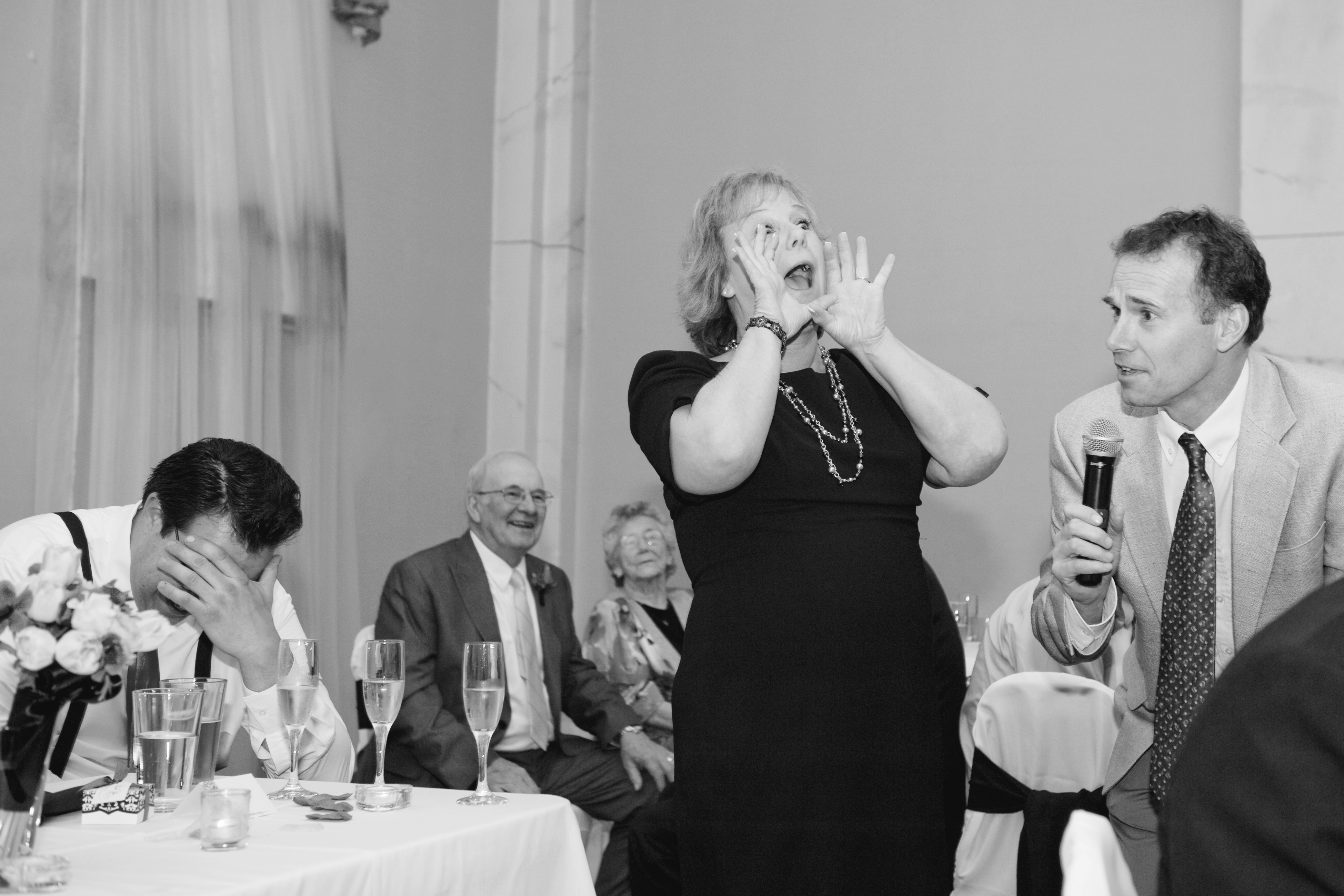
The corollary to this rule is that evidence-based Karaoke-ers use dancing to optimize their performance. This probably goes without saying, but I’ll say it anyway, “Be solution-focused and go with your strengths!” If your voice is bad or the lyrics are bad or you’re so nervous you’ve lost your ability to read, DANCE BIG. I did this a few years ago when I planned a rap to the Simon and Garfunkle tune “Feeling Groovy” and it quickly became obvious that the audience mostly wanted to watch my radical rapping dance moves and so I just went with that. The fact that no one at that party will talk to me anymore is irrelevant. I think it’s mostly because I intimidated the heck out of them and so they’re afraid to approach me now. I should note that this is a particular cognition that my counselor and I decided I shouldn’t test . . . so I’m just going with it. Here’s a photo of that performance. Apparently all the video recordings were lost or burned.
The fourth and final Karaoke rule is this: “A pill is not a skill . . . but Karaoke is a thrill.” What this means is that if you want to grow up to be a bad-ass Karaoke singer like me, then you have to practice, practice, and then practice some more . . . because as they say about counseling and counselors, all we ever do is practice.
There is no final performance.
There is no end to your learning.
And this is not my final goodbye to you.
I will be thinking of you all and wishing and hoping you the best success in whatever you choose to practice, knowing that I’ve had the excellent fortune and gift of time with you and that I’ve come to believe deeply in your ability, skill, compassion, and character.
One time when I was working with a dad and his son in counseling, the dad got right in his son’s face and delivered him a message that he would never forget. And so I want to end by sharing that message with you in hopes that you will hear it over-and-over in your brain:
“I will always be proud of you.”
Thanks for listening. Thanks for reading. Thanks for watching.
And thanks for being different.
P.S. I’m available for Karaoke tutoring and supervision and I can show you some hand movements, that, in particular, will blow your mind and insure an unforgettable Karaoke experience.
In about 10 days I’ll be on my way to Chicago to video-record five short lectures on Clinical Interviewing. Alexander Street Press is producing this video project and Dr. Sharon Dermer of Governor’s State University is hosting. The project is titled “Great Teachers, Great Courses.” [This is pretty cool and my thanks to JC for getting me included.]
I’ll be recording the morning of Tuesday, May 19, which happens to be just before Debbie Joffe Ellis, who just happens to be the wife of the late Albert Ellis. She asked to switch times with me and so I obliged, noting in an email to Dr. Dermer:
Sure. I can do morning. Besides, if I said no I would end up with the Ghost of Albert Ellis’s scratchy voice in the back of my head saying things like, “What the Holy Hell is wrong with you?”
I’d just as soon avoid that.
All this is my slightly braggy way of explaining why I’ll be writing about five upcoming blogs on Clinical Interviewing. Here we go.
What is a Clinical Interview?
Definitions can be slippery. This is especially true when our intention is to define something related to human interaction.
One of my favorite descriptions of clinical interviewing is scheduled for inclusion in the forthcoming “Handbook of Clinical Psychology.” Mostly I suppose I like this description because I wrote it (smiley face). Here it is:
In one form or another, the clinical interview is unarguably the headwaters from which all mental health interventions flow. This remarkable statement has two primary implications. First, although clinical psychologists often disagree about many important matters, the status of clinical interviewing as a fundamental procedure is more or less universal. Second, as a universal procedure, the clinical interview is naturally flexible. This is essential because otherwise achieving agreement regarding its significance amongst any group of psychologists would not be possible. (page numbers tbd)
When it comes to formal definitions, it’s clear that clinical interviewing has been defined in many ways by many authors. Some authors appear to prefer a narrow definition:
An interview is a controlled situation in which one person, the interviewer, asks a series of questions of another person, the respondent. (Keats, 2000, p. 1)
Others are more ambiguous:
An interview is an interaction between at least two persons. Each participant contributes to the process, and each influences the responses of the other. However, this characterization falls short of defining the process. Ordinary conversation is interactional, but surely interviewing goes beyond that. (Trull & Prinstein, 2013, p. 165)
Others emphasize the development of a positive and respectful relationship:
. . . we mean a conversation characterized by respect and mutuality, by immediacy and warm presence, and by emphasis on strengths and potential. Because clinical interviewing is essentially relational, it requires ongoing attention to how things are said and done, as well as to what is said and done. The emphasis on the relationship is at the heart of the “different kind of talking” that is the clinical interview. (Murphy & Dillon, 2011, p. 3)
From my perspective, the BIG goals of this “different kind of talking” can be broken into two main parts: (1) ASSESSMENT and (2) HELPING That said, I’m likely to further break these two main parts into four interrelated and overlapping parts that may or may not be formally including in a single clinical interview:
1. Establishing a therapeutic relationship
2. Collecting assessment information
3. Developing a case formulation or treatment plan
4. Providing a specific educational or psychotherapeutic intervention
What are the Goals of a Clinical Interview?
[In the following two paragraphs I’m including a more wordy and erudite way of saying the preceding . . . which is one of the things that we academics are wont to do. I should note these paragraphs are excerpted from my entry in the Encyclopedia of Clinical Psychology (2015). This piece, very recently published, is cleverly titled, “The Clinical Interview” and coauthored with Drs. Waganesh Abeje Zeleke, and Meredith H. E. Hood.]
Perhaps the clearest way to define a clinical interview is to describe its purpose or goals. Generally, there are four possible goals of a clinical interview. These include: (a) the goal of establishing (and maintaining) a working relationship or therapeutic alliance between clinical interviewer and patient; research has suggested the relationship between interviewer and patient is multidimensional, including agreement on mutual goals, engagement in mutual tasks, and development of a relational bond (Bordin, 1979; Norcross & Lambert, 2011); (b) the goal of obtaining assessment information or data about patients; in situations where the goal of the clinical interview is to formulate a psychiatric diagnosis, the process is typically referred to as a diagnostic interview; (c) the goal of developing a case formulation and treatment plan (although this goal includes gathering assessment information, it also moves beyond problem definition or diagnosis and involves the introduction of a treatment plan to a patient); (d) the goal of providing, as appropriate and as needed, a specific educational or therapeutic intervention, or referral for a specific intervention; this intervention is tailored to the patient’s particular problem or problem situation (as defined in items b and c).
All clinical interviews implicitly address the first two primary goals (i.e., relationship development and assessment or evaluation). Some clinical interviews also include, to some extent, case formulation or psychological intervention. A single clinical interview can simultaneously address all of the aforementioned goals. For example, in a crisis situation, a mental health professional might conduct a clinical interview designed to quickly establish rapport or an alliance, gather assessment data, formulate and discuss an initial treatment plan, and implement an intervention or make a referral.
What Happens During a Clinical Interview?
The range of interactions that can happen during a clinical interview is staggering. This could partly explain why we (foolishly) wrote a textbook on this topic that’s 598 pages long and includes an instructional DVD.
My son-in-law says one good way to get a flavor for any book is to put together the first and last words. In this case, our Clinical Interviewing text reads (not including the front or back matter), “This . . . culture.” To give you a further taste of “This . . . Clinical Interviewing . . . culture,” here’s a modified excerpt from the text:
Imagine sitting face-to-face with your first client. You carefully chose your clothing. You intentionally arranged the seating, set up the video camera, and completed the introductory paperwork. You’re doing your best to communicate warmth and helpfulness through your body posture and facial expressions. Now, imagine that your client:
Refuses to talk.
Talks so much you can’t get a word in.
Asks to leave early.
Starts crying.
Tells you that you’ll never understand because of your racial or ethnic differences.
Suddenly gets angry (or scared) and storms out.
Any and all of these responses are possible in an initial clinical interview. If one of these scenarios plays out, how will you respond? What will you say? What will you do?
From the first client forward, every client you meet will be different. Your challenge or mission (if you choose to accept it) is to make human contact with each client, to establish rapport, to build a working alliance, to gather information, to instill hope, and, if appropriate, to provide clear and helpful professional interventions. To top it off, you must gracefully end the interview on time and sometimes you’ll need to do all this with clients who don’t trust you or don’t want to work with you. (pp. 3-4)
In my opening Great Teachers, Great Courses lecture I’ll be focusing on the definition of the clinical interview and then limit myself to describing and demonstrating about 18 different interviewing “behaviors” or responses that clinicians who conduct clinical interviewing have at their disposal. These behaviors are named and organized into three categories. And so to help myself stop writing this blog and get back to work, I’ll wait and write about them later.
This is my friend Gary’s blog. He likes to stay under the radar. But he’s such a good writer that I want to share this anyway and he never told me not to. So there. That’s what I like to say. John SF
I hope I’m wrong, but I have a sense that this summer may be hot and dry with all the consequences we’ve come to expect. The best paddling this season might be in May or June rather than later in the year. When the forecast for a Tuesday in late April predicted 75 degrees and waves less than a foot tall, I decided to ignore the laundry, dandelions in the front yard and my need for a haircut, as well as a few more serious responsibilities.
After winter, even a mild one by Montana standards, I need reassurance that life at 47 degrees latitude shows signs of rejuvenation. On a scale larger than my back yard or the slope leading down to the stream I want to see evidence of the generative and recuperative power of the earth. I want to see arrowleaf balsamroot in bud and bloom, a bee…







 John Sommers-Flanagan